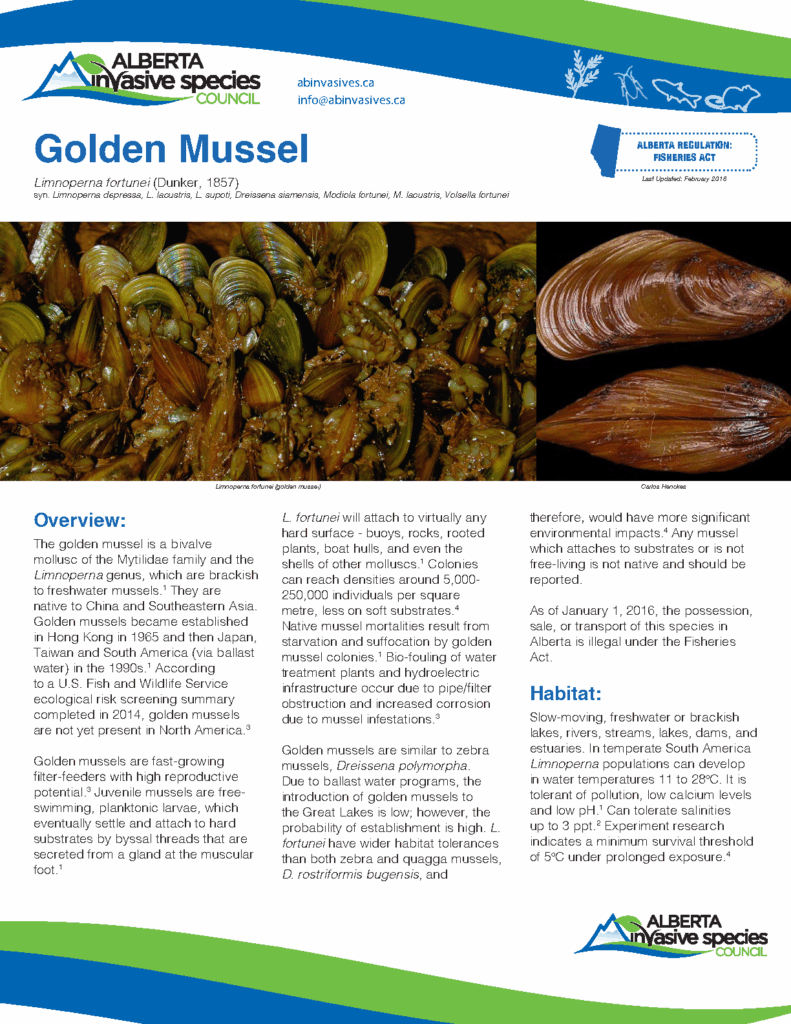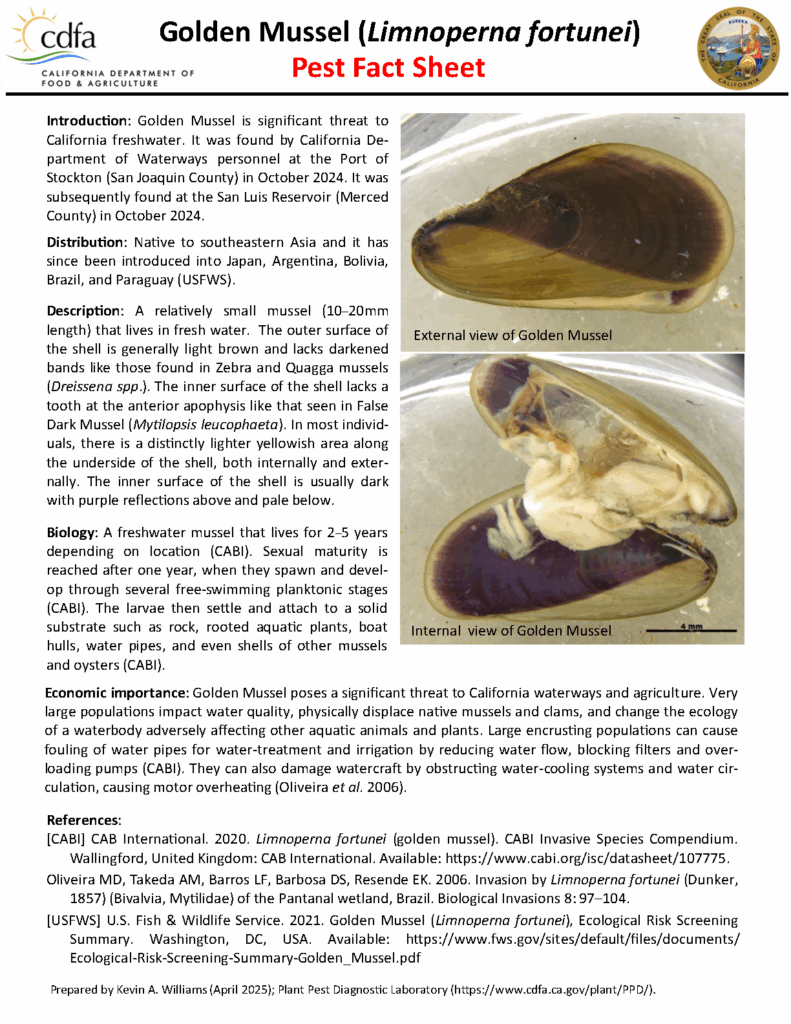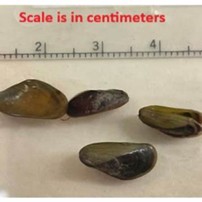
The golden mussel is a small freshwater bivalve in the family Mytilidae. Adults are typically 2-3 centimetres long, and in some populations can reach about 4 centimetres. Their shells range in colour from golden yellow to brown and may darken with age. The shell is smooth and wedge-shaped, and unlike some other mussels it does not sit flat when placed on a surface. Inside, the shell is pearly purple above the keel and white below.
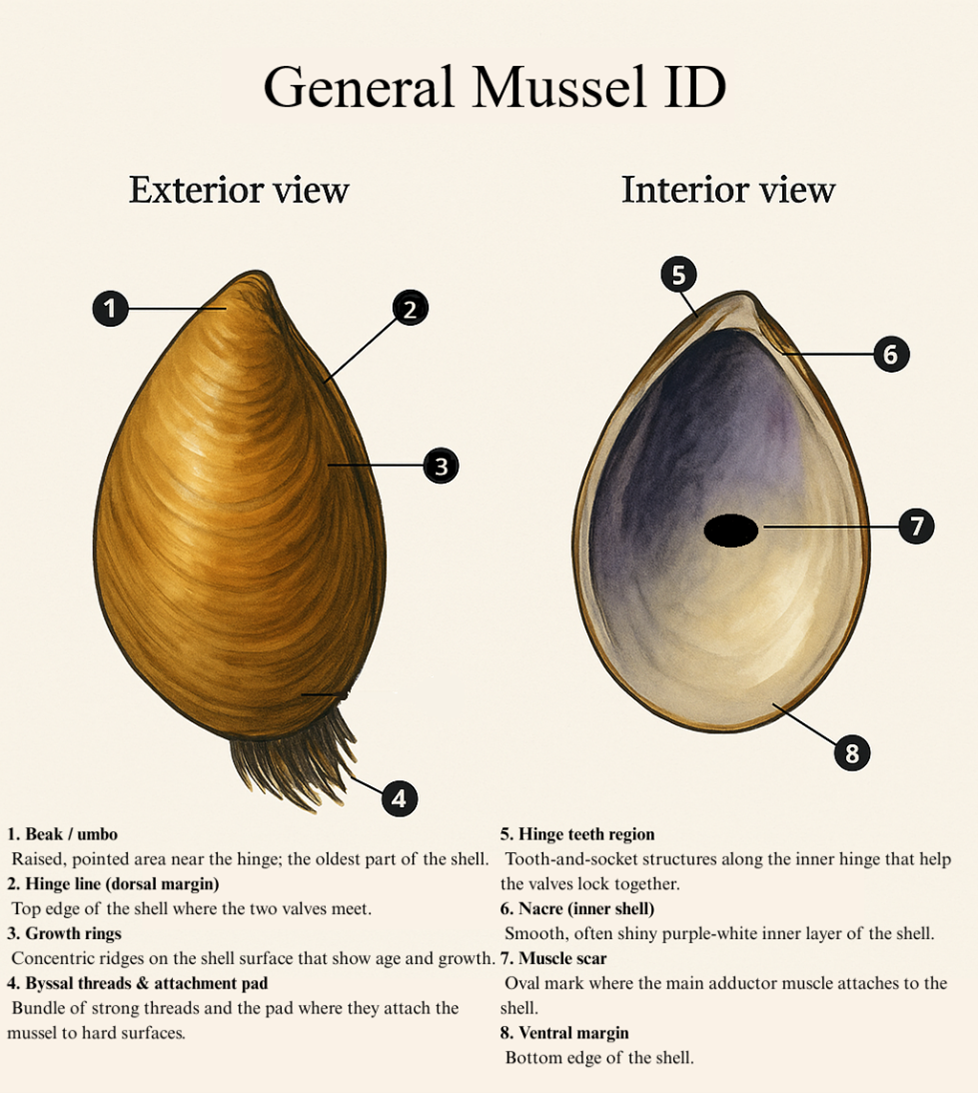
Golden mussels attach themselves very firmly to hard surfaces using strong byssal threads. These threads extend from underneath the shell and allow the mussels to cling to rocks, docks, intake pipes, and even to other mussels. In suitable habitats, they are often found in dense clusters covering these surfaces.
Several features can help distinguish golden mussels from other invasive mussels. Their shells are typically a more uniform golden-brown rather than strongly striped. The shell is smooth and wedge-shaped, with no hinge teeth and no byssal notch on the inside. In contrast, zebra and quagga mussels often have a more triangular or “D”-shaped shell that can sit on a flat surface, and they usually display darker striping or banding patterns. Zebra and quagga mussels also tend to have a chalky white shell interior, rather than the nacreous purple-and-white interior seen in golden mussels.
Golden mussels are native to rivers and lakes in Southeast Asia. From this native range, they have expanded into new regions with the help of human activities.
They were first introduced to South America in the early 1990s, most likely through ballast water discharged from ocean-going ships. Since then, golden mussels have spread widely through the Paraná–Paraguay and La Plata river basins. In these systems, they form dense colonies on both natural and artificial hard surfaces and have become a serious biofouling problem for hydropower plants, industrial facilities, and water treatment infrastructure.
In North America, the first record of golden mussels was confirmed in October 2024 in the Sacramento–San Joaquin Delta in California. Work is ongoing to understand the extent and status of these populations. At this time, there are no known established populations of golden mussels in the Great Lakes or in Ontario. However, risk assessments indicate that many Canadian waterbodies, including parts of the Great Lakes, have environmental conditions that are suitable for golden mussels if they are introduced.
Typically found in slow-moving, brackish or freshwater lakes, rivers, streams, dams, and estuaries. Golden mussels are successful invaders in part because they tolerate a wide range of environmental conditions. They can survive temperatures from approximately 5-35 °C and can persist for extended periods in near-freezing winter water (0-5 °C). They tolerate pH levels around 6–9 and can survive in relatively low-calcium waters, with reported survival at calcium concentrations as low as about 3–5 mg/L. They can also withstand short-term exposure to low salinity, which helps them survive in ballast water and other transport pathways. These broad tolerances mean that golden mussels could potentially establish in many lakes and rivers across North America, including colder and lower-calcium systems that might be less suitable for other invasive mussels.
Golden mussels reach sexual maturity within their first year and spawn one to two times annually when water temperatures range from 16–28°C. Fertilized eggs develop into planktonic veliger larvae, which pass through three growth stages over 30–70 days before settling and attaching to surfaces using byssal threads. They mature at about 5.5 mm in length and live for roughly 3.2 years. Adults feed on algae, zooplankton, and organic matter, while larvae feed primarily on bacteria.
Ecological impacts of golden mussels
Golden mussels can have large impacts on the ecosystems they invade. As filter feeders, they remove phytoplankton and other suspended material from the water, reducing food available for native plankton, invertebrates, and the species that depend on them. This intensive filtering can increase water clarity, changing how sunlight penetrates the water and favouring the growth of certain aquatic plants.
By concentrating filtered material and waste on the bottom, golden mussels alter nutrient cycling and shift energy from open water to nearshore and bottom habitats. Dense colonies can out-compete native mussels and other filter feeders for food and space, and may attach directly to native mussel shells, stressing or killing threatened freshwater mussel species. These changes can ripple through the food web, affecting invertebrates, fish, and other wildlife.
Economic and infrastructure impacts
Golden mussels are major biofouling organisms. Their ability to rapidly colonize hard surfaces allows them to clog water intake structures, such as pipes, screens, and cooling systems. This reduces pumping capacity for power generation, industry, and water treatment plants, and increases maintenance and operating costs. Golden mussels can also heavily foul aquaculture gear and cages, requiring frequent cleaning and equipment replacement.
Social and recreational impacts
In invaded waters, golden mussels can colonize docks, breakwalls, buoys, boats, and cottage intake pipes. This fouling can add drag to boats, increase wear on equipment, and raise maintenance costs for recreational and commercial users. Accumulations of sharp shells along shorelines and on structures pose a hazard to swimmers and pets and can reduce the overall recreational value of affected lakes and rivers.