

September 23, 2025
Beech trees play an important role in Ontario’s forests. Among them is the American beech tree (Fagus grandifolia), a native and ecologically significant species in North America. Its smooth, light-grey bark is easily recognizable, and its branches provide shelter for birds, insects, and other wildlife. These trees also produce nutrient-rich beechnuts, an important food source for black bears, game birds, and squirrels. Unfortunately, beech trees – including American beech – are now under threat from a new pest known as beech leaf disease (BLD).
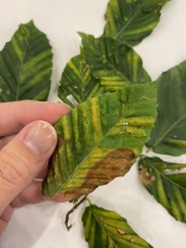
In Ontario, BLD was first detected in 2017 and has since been rapidly spreading, with reports ranging from Windsor in the southwest to Prince Edward County in the east. It is thought to be caused by an invasive foliar-feeding nematode (Litylenchus crenatae ssp. Mccannii) which feeds on leaf tissue and causes mortality (especially for understory trees) in two to five years. The key identifying feature of BLD is dark interveinal banding on leaves, which can sometimes be easier to see when holding the leaves up to a light source. Dark banding is caused by nematode feeding and is visible as soon as leaves emerge in the spring. This feeding damage can make it difficult for infested trees to photosynthesize, meaning they produce less energy for growth in the summer. The leaves will worsen each year as nematode populations increase, often becoming thicker, curled, and leathery. In severe cases buds can even fail to produce new leaves altogether.
Ontario Trillium Foundation Seed Grant
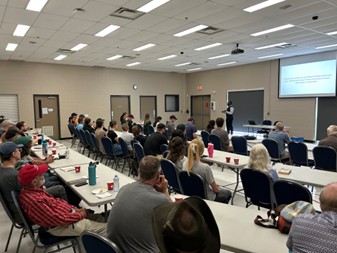
The Invasive Species Centre (ISC) has recently received support through a $23,600 Seed grant from the Ontario Trillium Foundation (OTF). With support from OTF and the Ministry of Natural Resources (MNR), the ISC has expanded awareness, monitoring, and sampling efforts of BLD through a new community science initiative—the Beech Leaf Disease Monitoring Network. Through the funding, a Beech Leaf Disease Workshop was hosted in Brighton, ON, where 45 people gathered to learn how to identify and report BLD. Beech leaf disease is still quite new to Ontario, so research is incredibly important to learn more about how it spreads and what we can do to protect beech. This funding will support BLD sample collection, which can help researchers better understand where the disease is found in Ontario, how fast it’s spreading, and more.
What can you do?
Community science is one of the most effective ways to track invasive species, and BLD is no exception. What can you do to protect beech?
- Watch for signs of beech leaf disease
- Report sightings to iNaturalist or EDDMapS. These reports are verified by experts and can help inform future research
- Collect and submit leaf samples to support ongoing research! Learn how by sending us an email at training@invasivespeciescentre.ca
- Join the Beech Leaf Disease Monitoring Network through the ISC website to receive updates, resources, and opportunities to get involved
- Learn more about how to manage the disease by checking out the ISC’s BLD species profile.
