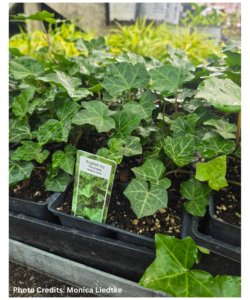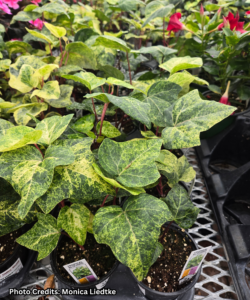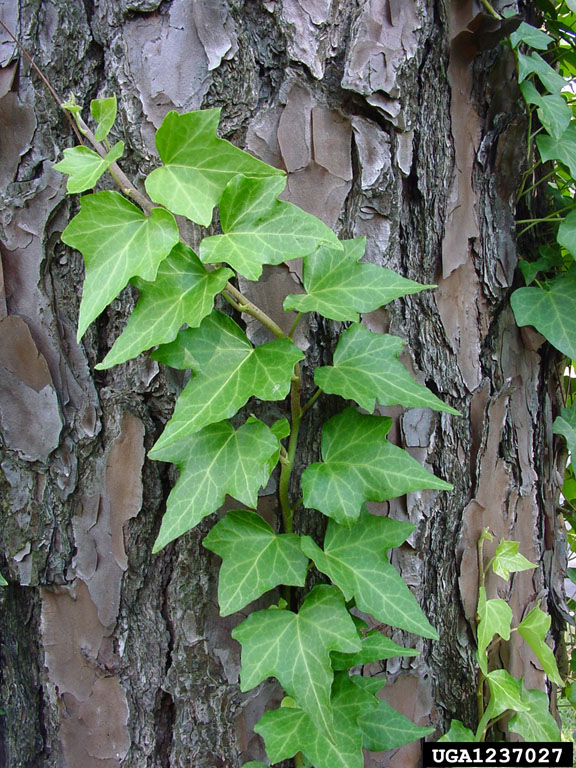
English Ivy is an evergreen vine that climbs or sprawls. Its appearance varies with the plant’s maturity.
Juvenile leaves have 3-5 lobes that are spread outward from a single point, like a maple leaf or a hand.
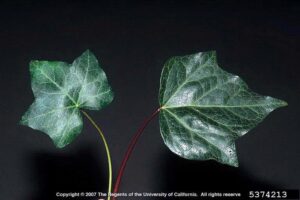
Adult leaves are heart-shaped and usually found on flowering stems or on stems in full sun.
In both cases, leaves connect to the main stem by a 1.5-2 cm petiole (leaf stalk).
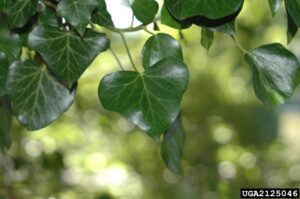
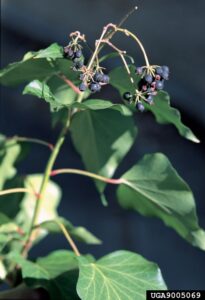
Fruiting Stem Leaves: Leaves are heart-shaped
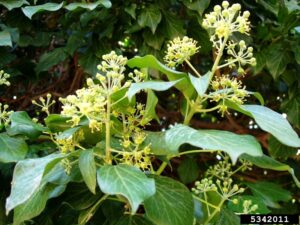
Flowers: Clusters of small white or yellow flowers that bloom in late summer.
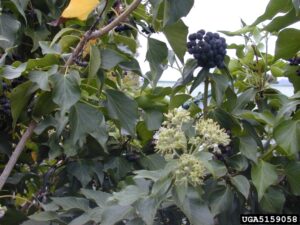
Fruit: Clusters of black shiny fruit follow the flowers in early fall.
On the ground, English ivy is less than 30cm tall and can sprawl for over 20 metres.
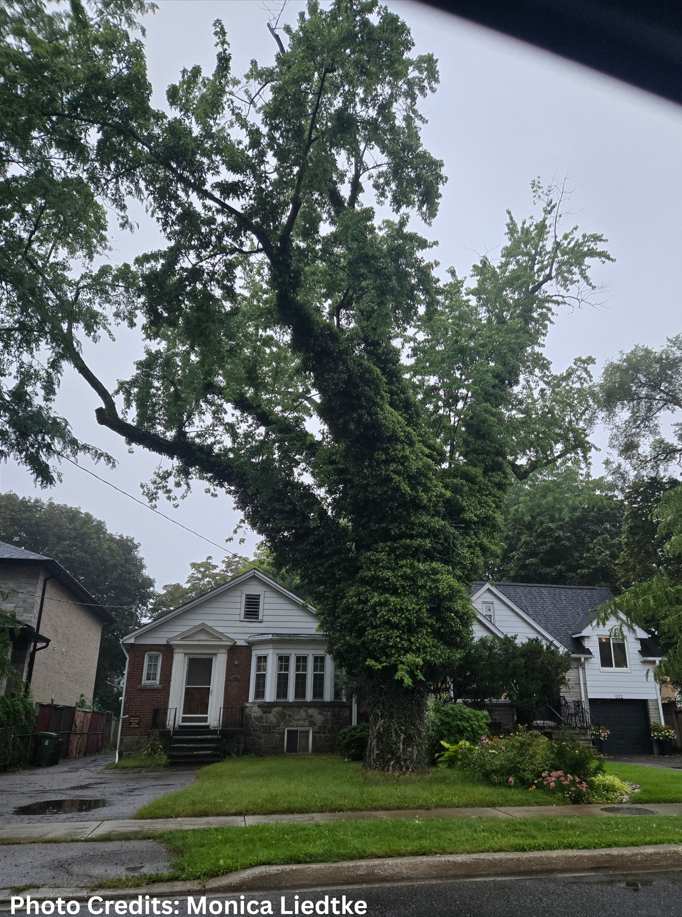
English ivy can climb over 20 metres up sturdy structures and trees. Additional shoots can sprout off the climbing stem, resulting in a bushy appearance.
Native to Europe, Western Asia, and Northern Africa, English Ivy is an evergreen perennial vine. It is believed that English Ivy was introduced to North America in the 1700s as an ornamental ground cover.
Nodes along the creeping stem can root when in contact with almost any soil type, enabling vegetative spread. Fragments of the main stem containing nodes can also sprout roots, highlighting the importance of removal that avoids fragmenting the stem.
English Ivy’s ability to sprawl over 20 metres and form roots at nodes makes it a risk to areas beyond the garden border.
English Ivy can reproduce through seed, as birds eat the berries.
English ivy can grow in a variety of habitats including woodlands, forests, fields, roadsides, and coastal areas. It prefers semi-shady and moist soil; however, sunlight encourages flowering and fruiting.
English ivy can sprawl or climb. Climbing vines may damage buildings, fences, and trees.
Once established, English ivy needs little light or water.
English Ivy is established in British Columbia and Southern Ontario. It is still widely available in most garden centres as an ornamental plant and is hardy in zones 4 through 9, making many regions at risk of this plant escaping gardens.
Native plant growth is restricted where English ivy grows as a ground cover. Growing up to 30cm tall, it smothers and blocks sunlight from other plants.
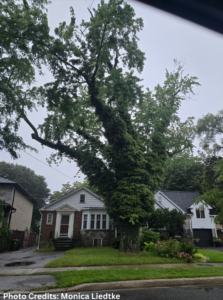
English ivy climbing on trees can loosen bark and hold moisture to the trunk, making the tree vulnerable to fungal diseases, rot, and decay. It can serve as a vector for Bacterial Leaf Scorch (Xylella fastidiosa), a pathogen that harms hardwood trees and other native plants.
The weight of the vines may also make trees more susceptible to falling or breaking during wind, snow, and ice accumulation. English ivy may also damage buildings and structures.
English Ivy is still available for purchase at most garden centres and online. Some municipalities in British Columbia have banned the sale of English Ivy.