
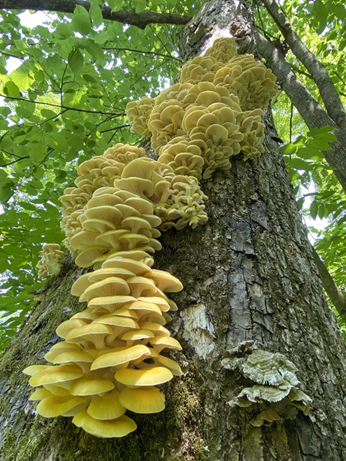
The focus on this description is to identify the fruiting body, or mushroom, of the Golden Oyster Mushroom, which is the most visible feature. Most of the year the fungus exists as a mycelium and is virtually undetectable.
Identifying Golden Oyster Mushroom
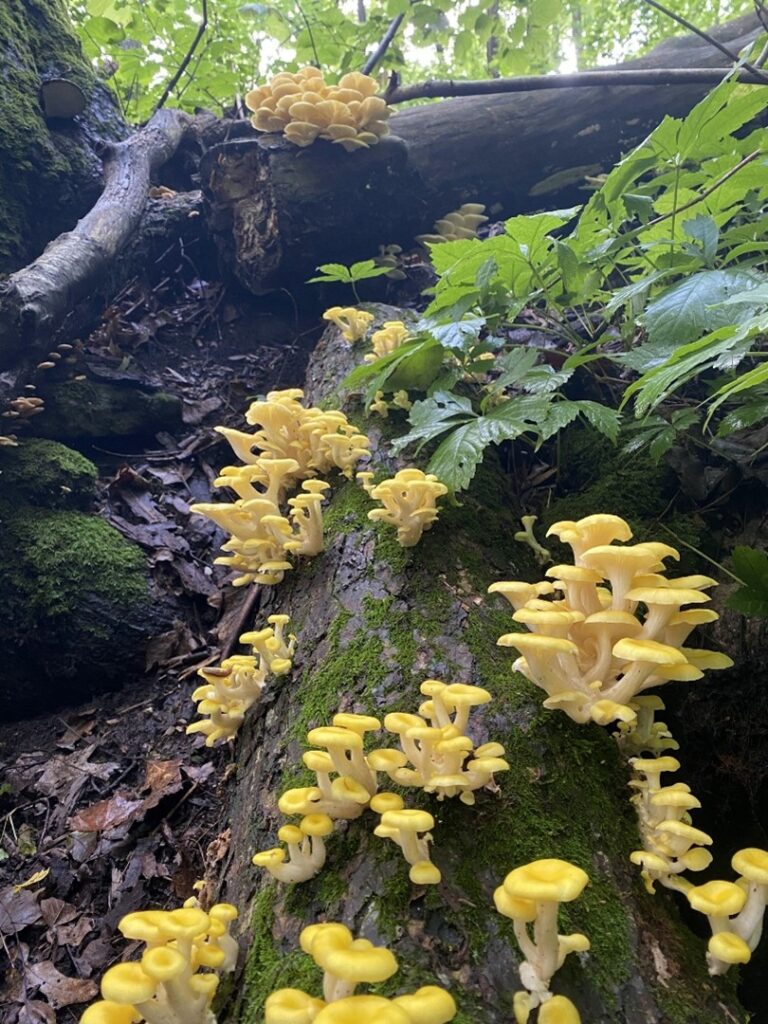
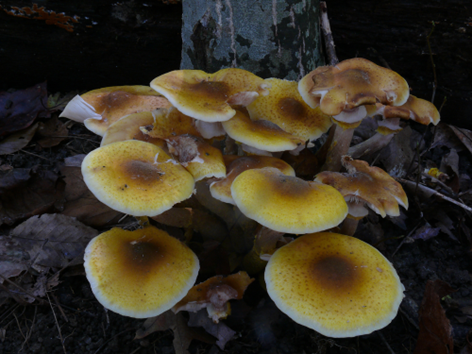
Cap: GOM can be identified by its cap which is bright yellow and vibrant when young and fades to a pale yellow or white with age (Singer 1943). Caps are typically 2 to 8 centimeters in diameter and have a central depression which can give them a funnel-like shape when mature. When young, the edges are curved but can flare or become wavy as they age.
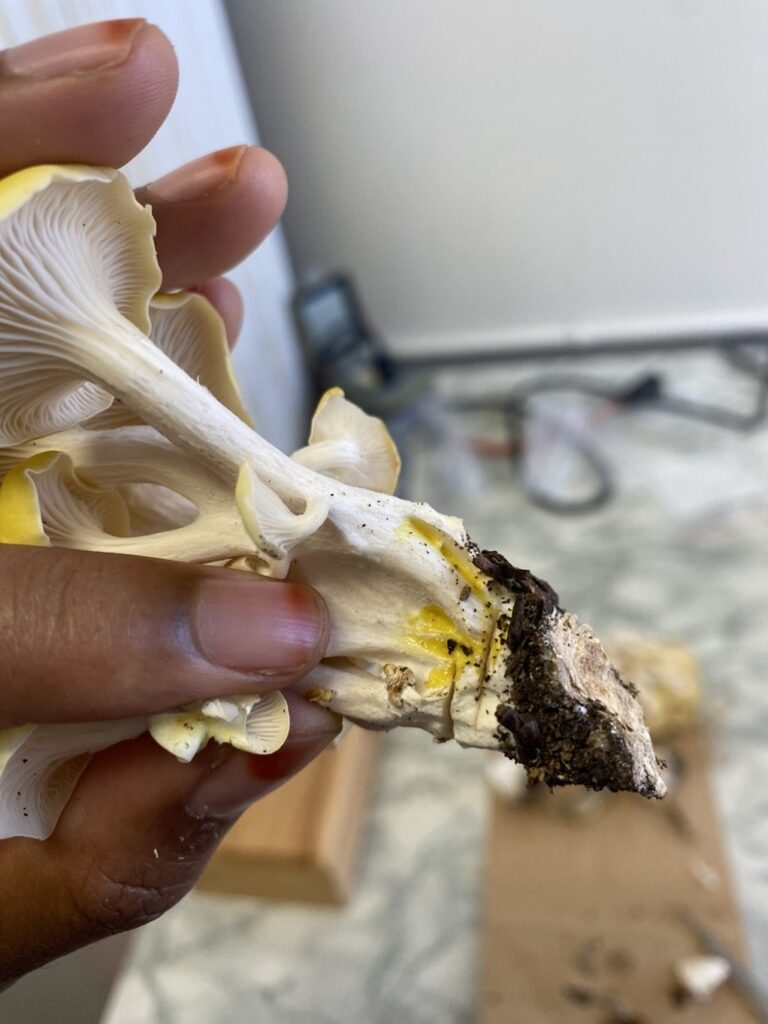
Stem and gills: The stems of GOM are white, subcentral, branched, and joined together at the base since these mushrooms tend to grow in large clusters (Bruce, 2018). As a result of cluster density, stems are usually curved or bent. An identifying feature of this fungus is its deterrent white gills; the gills attach directly to the mushroom stem and run down its length.
Spores: Known for a heavy spore load, gilled mushrooms, like GOM, can produce and release billions of spores a day (Hassett et al., 2015). GOM’s spores, like the spores of other mushroom species, are microscopic and invisible to the naked eye. Under a microscope GOM’s spores will appear whitish-pink, ellipsoid shaped, and 5–10 micrometers in length.
Odour: Strong unpleasant odour when past maturity. When fresh, GOM has been described by foragers to have a mild pleasant odour ranging from a light earthy scent to a watermelon/fruity scent to a seafood or fishy aroma.
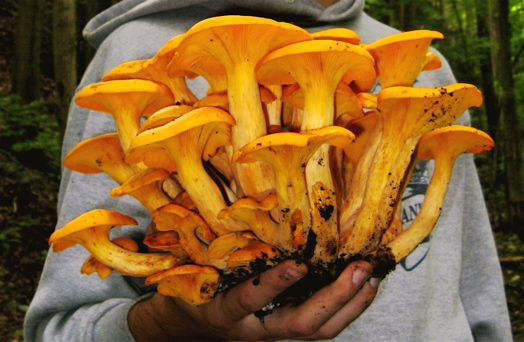
There are a few look-a-like fungal species that can be mistaken for GOM. One species is the toxic Jack-o’-Lantern mushroom (Omphalotus illudens). These mushrooms are typically darker in colour (more orange than yellow) and have gills that only run partway down the stem, unlike GOM who have decurrent gills. Jack-o’-Lanterns also grow in larger clusters and have the ability to glow in the dark.
Another common look-alike species are honey mushrooms (Armillaria mellea) which have a similar yellow-brown coloration and also grow in clumps. This species however has slightly scaly caps, and its gills are not strongly deterrent.
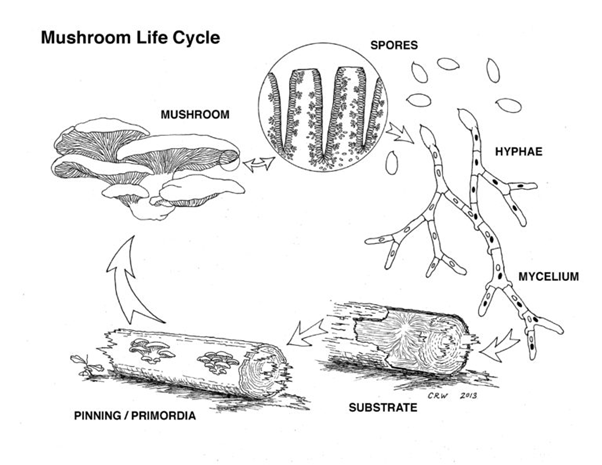
The life cycle of an oyster mushroom, like other basidiomycetes, starts with the release of basidiospores from the fungus’s mature fruiting body (mushroom) and the germination of these spores in a suitable substrate (typically decaying hardwood species like elm, oak, maple, or black cherry). If the environmental conditions are favorable, the basidiospores will germinate to form hyphae, thread-like structures that are the building blocks of fungal growth. When compatible hyphae meet, they fuse and over time form a complex network known as a mycelium (Nwankwegu et al., 2025). GOM will spend the majority of its existence as a mycelium network, hidden beneath soil or wood and invisible to the naked eye, and the visible reproductive organ, the mushroom, will only be visible for a few weeks to allow the production and release of spores. The mycelium network will continue to grow and expand, anchoring the fungus in its substrate and helping it absorb nutrients from the environment. When environmental conditions, including temperature, humidity, and oxygen levels are optimal, the mycelium will begin to develop its fruiting body (Martínez-Carrera, 1998; Nwankwegu et al., 2025). First through the production of hyphal knots and then primordia, a mature mushroom composed of a cap, stem, and gills finally develops. The basidia under the gills of this mature fruiting body are ready to release millions of whitish coloured basidiospores to restart the fungal life cycle.
Golden oyster mushrooms are wood decay fungi and are commonly found growing on dead deciduous hardwood species including oak, elm, and beech but have also been spotted on black cherry, maple, ash, cottonwoods, mulch, and straw (Veerabahu et al., 2025). They have a strong preference for dead elm trees and thrive in warm, humid deciduous hardwood forests. The distinct yellow fruiting body of the mushroom can be seen from May to September.
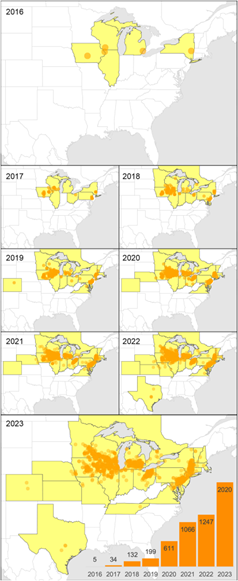
The native range of GOM is eastern Asian, including China, Taiwan, Japan, and eastern Russia. Thought to have escaped into the North American forests in 2010 following their intentional importation as cultivated edible mushrooms in the United States in the early 2000s, the first wild specimens were documented as single observations in 2013 (Athens, NY), 2014 (Madison, WI) and 2015 (OH) (Veerabahu et al., 2025). Since these first reports, 12,000 reports of GOM have been logged on iNaturalist in North America and the fungus has been documented in 25 middle and northeastern American states, and two Canadian provinces (ON and QC) (Hibbett et al., 2026; Veerabahu et al., 2025). Researchers have estimated that the species range now spans approximately 2 million km2. Due to their primary association with American elm trees, GOM’s current distribution in North America is similar to the distribution of this tree species. A map of GOM’s rapid spread based on community science observations submitted through iNaturalist and MushroomObserver platforms is available below. According to climate model predictions, GOM’s range will continue to expand under a warming climate to include many other areas in North America, such as Pacific hardwood forests, Alaska, Appalachia, and parts of Mexico (Veerabahu et al., 2025).
Ecological
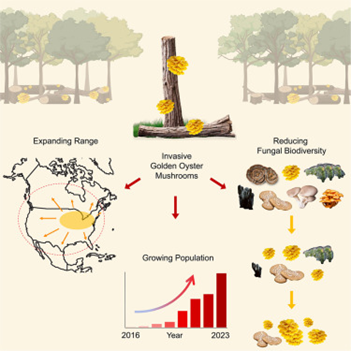
GOM isn’t known to be a risk to living trees but does have an important impact on the species diversity and community composition of native wood-inhabiting fungal species. A recent study found that elm trees colonized by GOM hosted about half of the fungal species of trees without GOM, with GOM host trees harbouring 22 fungal species and non-hosts harbouring 40 fungal species (Veerabahu et al., 2025). GOM colonization not only affects the diversity of the fungal community on trees, but also its composition, lowering species richness and increasing competition with native fungi. This competition with other decomposers could have profound impacts on entire forest ecosystems. GOM belongs to a group of fungi called white rot fungi which, due to their efficient ability to decompose lignin, a key structural component of wood and bark, release more carbon dioxide into the atmosphere than brown rot fungi, another group which cannot digest this component (Simpson et al., 2024). A key preoccupation is that GOM is modifying the community composition of wood-dwelling fungi in North American hardwood forests and may be shifting the balance towards increasing presence of white rot fungi. As a member of the white rot fungus group, GOM’s range expansion and aggressive competition with native fungal species may be associated with increased rates of wood decay and CO2 emission, leading to unpredictable and cascading ecosystem effects including loss of habitat for insects, birds, and small mammals.
Economic
Although GOM doesn’t pose a risk to living trees and thus has minimal impacts on the forestry sector, its rapid spread and competitive features pose a threat to native wood dwelling fungi. Loss of important native fungal species will decrease the genetic variability needed for fungi and forests to adapt to changing climates and perform essential ecosystem functions, such as carbon sequestration and nutrient cycling, services that are valued in the trillions globally (Costanza et al.,1997). The potential discovery of medicinal compounds produced by fungi will also be lost with a decline in native fungal diversity.
Social
Competition between the invasive GOM and native fungal species may threaten edible native species, changing the landscape and available mushrooms for foragers. Conversely, for novice foragers, GOM represents an accessible entry point into foraging since it is easy to find and correctly identify, helping teach and document the threat of invasive mushrooms.