
September 9, 2025
What is Japanese Stiltgrass?
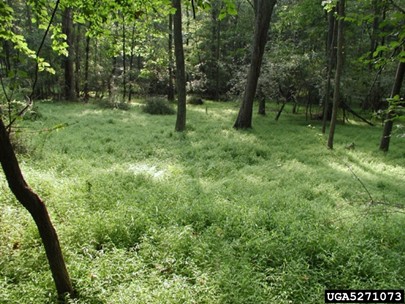
Japanese stiltgrass (Microstegium vimineum) is an invasive annual grass (Poaceae) that thrives in a wide range of habitats including forests, wetlands, lawns, trails, and roadways. It often forms dense, monospecific stands that outcompete native vegetation for access to light, nutrients, and space. By sprawling out in low-light areas, it reduces habitat quality and makes it harder for native plants to grow and reproduce.
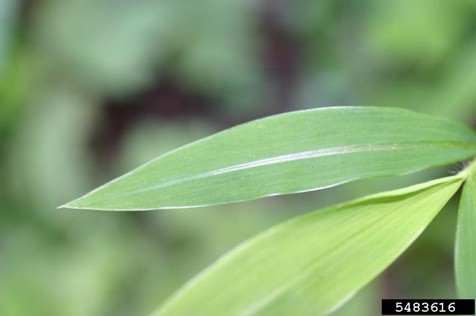
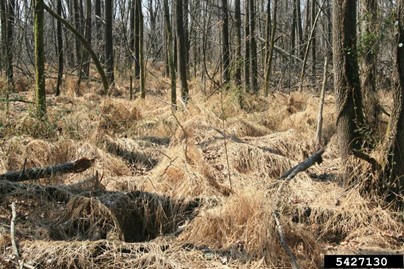
This plant is recognizable by its distinctive shiny midrib running along the center of each leaf blade. The alternate leaves are tapered at both ends and measure about 2.5-7.5cm (1-3in) long. It can reach heights of about 1m (3ft) tall with leaves that are green in the summer but turn slightly purplish come autumn during flower and seed production. In winter, dead stems remain as an orange-brown thatch that blankets the ground. It’s botanical name reflects these traits: Microstegium means “small roof,” referring to the thatch formed by dried stems, while vimineum means “with slender roots,” describing its thin, sprawling stems.
Where is it found and how does it spread?
This invasive plant was originally detected in Tennessee in the early 1900s and has since spread throughout the Eastern United and Midwestern United States. Populations have been established from New Hampshire to Florida, and westward to Texas and Iowa – a range spanning roughly 1,000 km (620 miles) north and south and 1,500 kilometers (930 miles) east to west. This wide distribution highlights the species’ adaptability and its potential to spread rapidly into new areas, making early detection and management especially important.
The first Canadian report was made in 2019 when it was found in Short Hills Provincial Park in southern Ontario. Seven distinct populations have been confirmed: One each in Elgin and Middlesex, two in Norfolk, one in Waterloo Region, and two in Niagara region. Surveys in 2024-2025 also detected the plant at eight additional locations within the Niagara region. These emerging patches could expand existing populations if not managed. To date, all known infestations are isolated to southern Ontario.
How to manage Japanese stiltgrass
Early detection and rapid action are key to preventing Japanese stiltgrass from establishing new populations. Japanese stiltgrass spreads primarily by seed, which can remain viable in the soil for up to seven years. Each plant is capable of producing 100- 1,000 seeds in a single growing season, which can amount to 16,000-50,000 seeds per square meter. These tiny seeds are easily transported by humans, wildlife such as deer, and even water, enabling the plant to spread rapidly across the landscape. For this reason, the primary management goal is to prevent seed production.
Mechanical control, such as hand pulling or mowing, is most effective in late summer just before flowering. Thanks to its shallow root system, hand pulling is simple, effective and works best for small patches when the soil is moist. For larger areas, well-timed mowing can help infestations and reduce seed production. When populations are more widespread or persistent, chemical control may be needed.
Pre-emergence herbicides can reduce seed germination but will also affect all species in the soil seedbank. Post-emergence herbicides, applied later in the growing season (June- August), can be applied directly to growing plants to minimize non-target impacts. Grass-specific herbicides provide another option that targets the plant more precisely, though they may also kill turfgrass.
How to Properly Dispose
Never discard garden waste in nearby natural areas. Avoid composting invasive plant material and seeds as they can sometimes survive the process. For invasive plant materials, dispose in construction grade plastic garbage bags, set out on a hard surface for one to two weeks in the sun and place in household waste. Refer to regional management guidelines or reach out to the local landfill for more specific information on disposal.
How to Prevent Japanese Stiltgrass from Spreading
Invasive plants often spread by seeds clinging to shoes, clothing, equipment, and even pets, moving from infested areas into new habitats. Cleaning off these items before leaving a site is an effective way to stop the spread of species like Japanese stiltgrass. Boot brushes are a useful tool for removing mud, dirt, and seeds from footwear before and after using trails. Sticking to designated paths and keeping pets leashed further reduces the risk of accidentally transporting seeds.
Do you think you’ve seen Japanese stiltgrass? Report the sighting immediately to EDDMapS. A good report includes a clear picture and accurate location.
Resources
Japanese Stiltgrass Species Profile: Invasive Species Centre
Japanese Stiltgrass: Monroe County – Identify and Reduce Invasive Species
Japanese Stiltgrass Detection in Short Hills Provincial Park: Invasive Species Centre Webinar
NC State University: Japanese Stiltgrass Identification and Management
