Access information about the 2026 research herbicide application trial in Cooks Bay here.
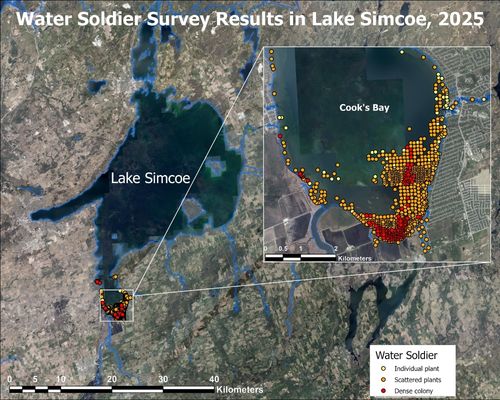
In 2024, a new population of water soldier was found in Lake Simcoe. Being the largest known population of water soldier in North America, the significance of Lake Simcoe as the largest inland lake in southern Ontario. The lake’s role is a vital source of drinking water for 500,000 residents, a working group, co-chaired by the Invasive Species Centre and Ontario Federation of Anglers and Hunters Foundation, was formed to take collaborative action.
The overall goals of the working group are to:
- Monitor and map this population of water soldier
- Work towards the restoration of Lake Simcoe by developing and executing an integrated pest management plan
- Raise awareness about water soldier and its impacts
- Prevent the spread of water soldier in Lake Simcoe and beyond
Table of Contents



What Is Water Soldier
Water soldier (Stratiotes aloides) is an invasive aquatic plant that grows in shallow water along shorelines, wetlands, and slow-moving rivers. Originally introduced as an ornamental plant for water gardens, it has spread into natural waterways where it can quickly establish and expand.
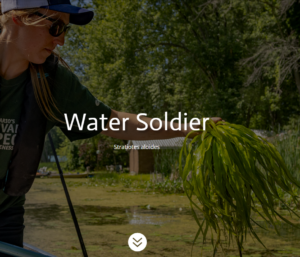
It looks similar to an aloe vera plant, with long, narrow, triangular leaves that grow in a rosette (circular cluster). The leaves are bright green and have sharp, serrated edges, which can easily cut skin if handled without gloves. Water soldier can float on the water’s surface or grow fully submerged, depending on the time of year.
During the growing season, it forms dense patches of vegetation that can crowd out native plants and take over nearshore areas.
Water soldier is listed as a prohibited species under the Ontario Invasive Species Act. This means it is illegal to import, possess, transport, grow, buy, sell, or release the plant in Ontario.
How to Identify Water Soldier
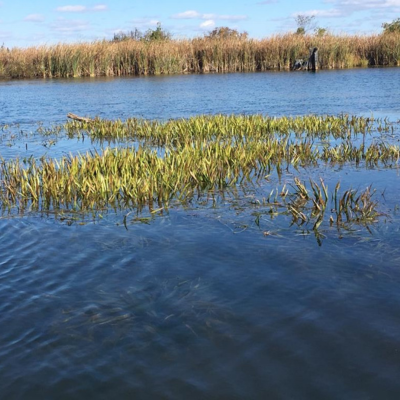
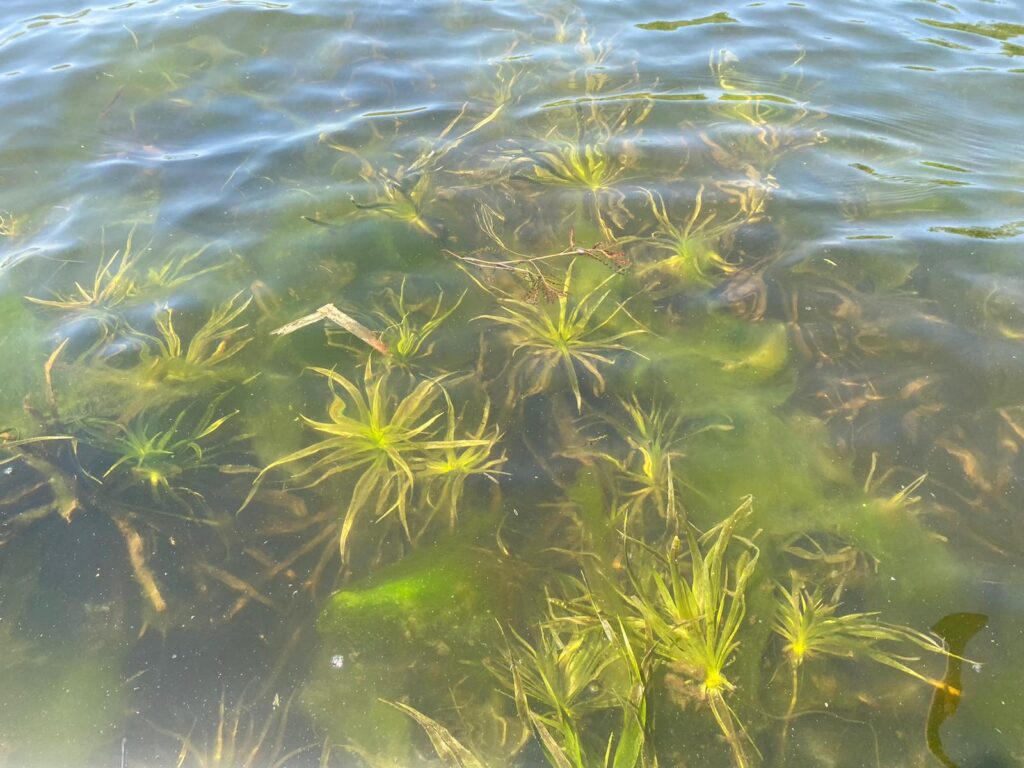
Cluster of water soldier: The plant forms dense mats of floating and submerged vegetation.

Leaves:
The leaves of this plant are 40 cm long and shaped like thin swords.
The leaves form a large circle and are bright green in colour.
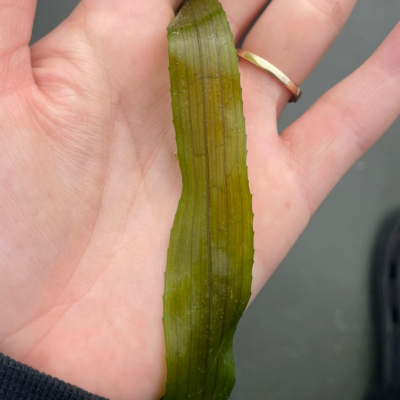
Leaf close-up: Sharp, serrated leaves can easily cut skin.
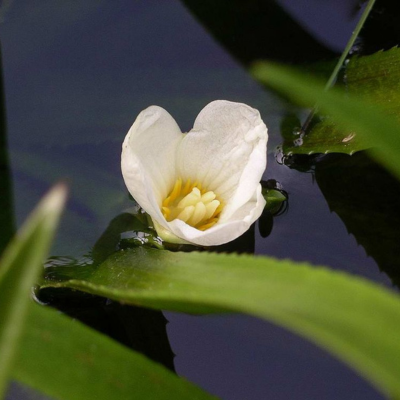
Flower: Some populations of water soldier produce small, white, three-petaled flowers in the summer. However, it’s important to note that populations in Ontario have rarely been found to produce flowers.
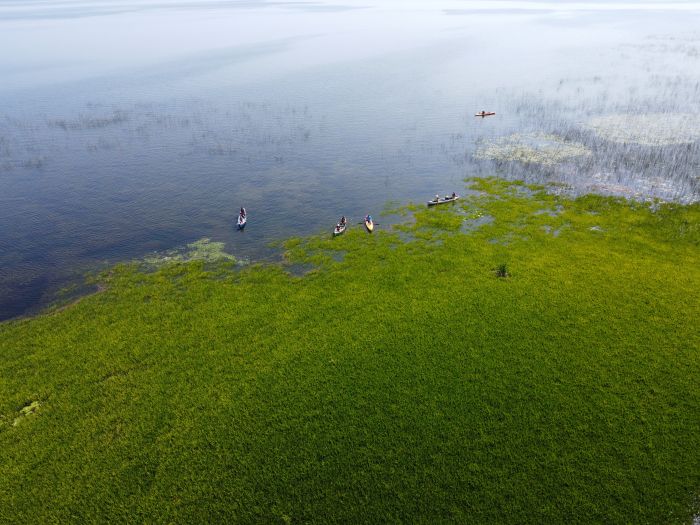
Where you might find water soldier: This plant prefers slow-moving, shallow waters rather than fast-moving waters, or waters that fluctuate in level. It is often found in back bays and along shorelines and can be lightly anchored in soft, muddy sediments.
Why It’s a Concern & What’s Being Done
Water soldier grows quickly, forming dense mats in shallow water that can limit recreational activities such as swimming, boating, and fishing. Its sharp, serrated leaves can also pose a safety risk to people and pets. By crowding out native plants and blocking sunlight, it can reduce biodiversity and impact local ecosystems, as well as recreation and shoreline use.
Water soldier was first detected in Cook’s Bay in summer 2024, near Young’s Harbour Park, after a member of the public reported the sighting – highlighting the importance of community reports. The Lake Simcoe Water Soldier Working Group, made up of federal and provincial ministries, Indigenous communities, municipalities, conservation authorities, and environmental organizations, is working together to monitor, map, and manage the infestation, including the development of an Integrated Management Plan for Water Soldier in Lake Simcoe.
Management approaches depend on the size and location of the population, and may include hand removal for small patches, mechanical harvesting for larger areas, and targeted herbicide treatments where appropriate. Timing is important to reduce the spread and protect native species. Control efforts are guided by Ontario’s Water Soldier Prevention and Response Plan.
More About the Integrated Management Plan
The Integrated Management Plan (IMP) is based on the best available science, local knowledge, and lessons learned from water soldier management in other locations across Ontario. It uses a landscape-scale approach that combines multiple management tools and involves collaboration among government agencies, Indigenous communities, conservation organizations, municipalities, researchers, and local stakeholders.
The plan is intended to be implemented in two phases:
Phase 1: Containment and evaluation (2026 and 2027)
- Prevent water soldier from spreading beyond Cook’s Bay.
- Continue surveillance for new detections.
- Implement targeted management activities with focused research outcomes.
- Complete monitoring and assessment of the management activities to evaluate their effectiveness.
Phase 2: Expand management and long-term control (2027 and beyond)
- Build on the Phase 1 results.
- Maintain containment efforts within Cook’s Bay.
- Expand management efforts to achieve long-term control.
Examples of Management Tools
Management approaches depend on the time of year, the plant’s lifecycle, and the size and location of the population. Management tools include manual removal by hand pulling, mechanical harvesting, and targeted herbicide treatments. Timely action can help maximize the effectiveness of management efforts, reduce the potential for further spread, and support the protection of native species.
Research Herbicide Application Trial Notifications
Two herbicide treatment applications took place during the week of October 5th 2026, along the west shore of Cook’s Bay and around the outlet of the Holland River. This was done as part of a research project to help identify control tools for water soldier.
Reward (Diquat dibromide)
Treatment was completed on Oct. 7, 2026, at 3 p.m.
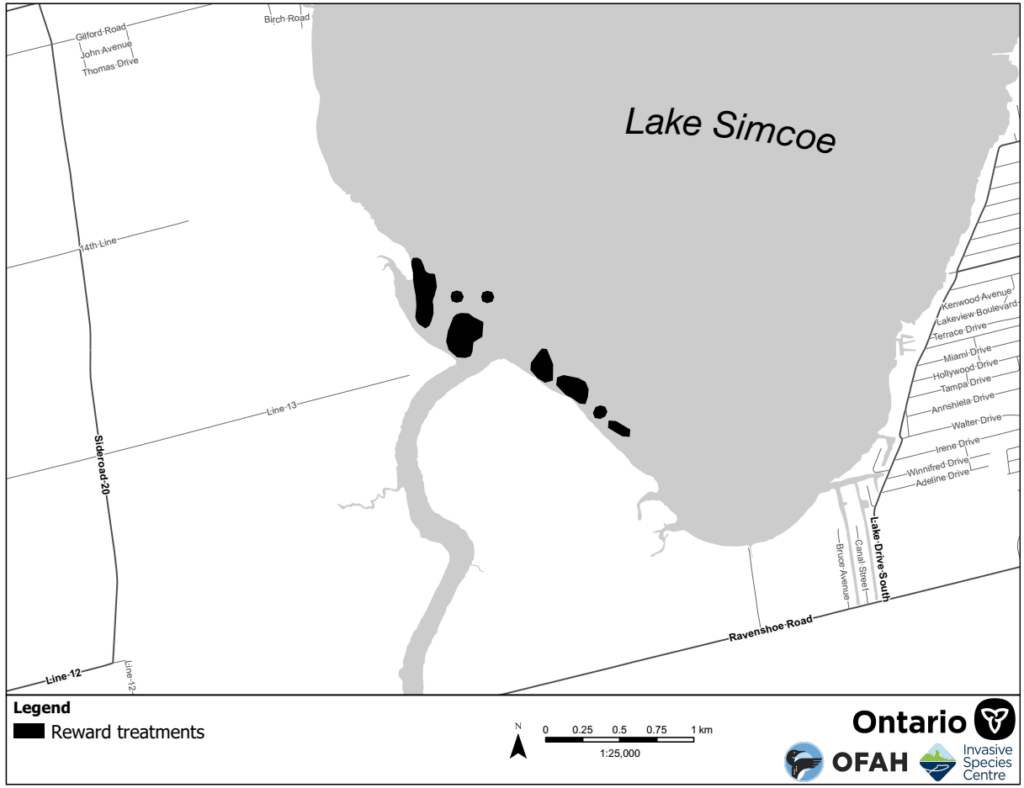
Herbicide: Reward® (Diquat dibromide) Herbicide (PCP#26271)
The water-use restrictions on the product label for Reward® Aquatic Herbicide are:
- Do not use water from the application site for at least 24 hours after the herbicide application for swimming or animal consumption.
- For human consumption and irrigation, do not use water for 5 days after the herbicide application.
- If you draw water from the highlighted areas for drinking water purposes, call 705-772-8798 or 705-716-4963 during regular business hours.
- Municipally treated drinking water is safe to consume unless the municipality informs you otherwise (i.e. boil water advisory).
- There are no restrictions on fishing or waterfowl hunting in the treatment areas.
If you use a shore well for drinking water that is connected to Cook’s Bay, within the treatment area, contact 705-772-8798 or 705-716-4963 for information about obtaining supplemental drinking water.
For more information about the aquatic herbicide application, call Glenn Sullivan, Ready Scout, 908-310-8775. Calls received after hours will be returned the next business day.
ProcellaCOR FX
Treatment was completed on Oct. 8, 2026, at 10 a.m.
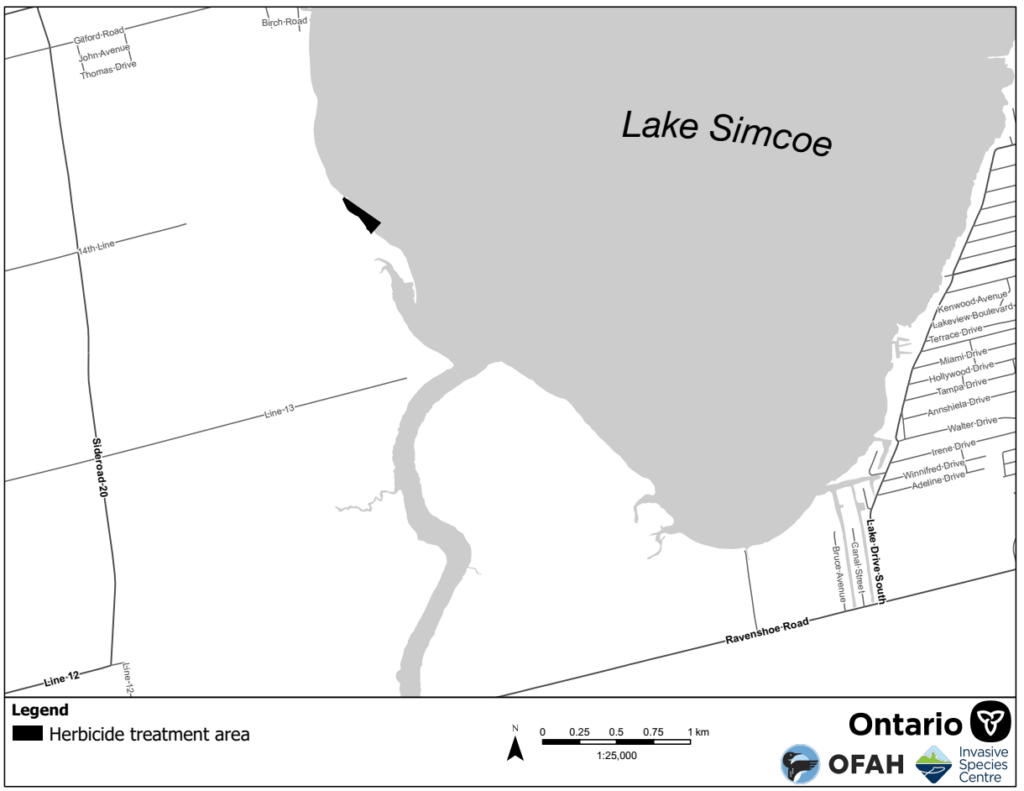
Herbicide: ProcellaCOR® (Florpyrauxifen) Herbicide (PCP# 34732)
There are no restrictions for drinking water consumption and recreational purposes, including swimming and fishing.
The water-use restrictions for ProcellaCOR® FX Aquatic Herbicide are:
- Do not use water from the application site for 5 days after treatment for irrigation use
For more information about the aquatic herbicide application, call Wagar & Corput Weed Control Inc. at 613-938-2117. Calls received after hours will be returned the next business day.
There are also opportunities from time to time for residents of the Lake Simcoe area to learn more about this population and how you can help prevent the spread through events such as workshops and site visits. Visit our events calendar to learn more.
This is a multi-year effort, and continued monitoring, management, and community awareness will be important to limit further spread within the lake.
Lake Simcoe Water Soldier Working Group:
- Chippewas of Georgina Island First Nation
- Chippewas of Rama First Nation
- Ducks Unlimited Canada
- Invasive Species Centre Co-chair
- Lake Simcoe Region Conservation Authority
- Ontario Federation of Anglers and Hunters Foundation Co-chair
- Ontario Ministry of Natural Resources
- Ontario Ministry of the Environment, Conservation and Parks
- Parks Canada
- Town of Georgina
- The Regional Municipality of York
How Water Soldier Got to Lake Simcoe
Water soldier is not native to Ontario and is unlikely to spread long distances on its own. Most introductions are linked to human activity, particularly through water gardens and ponds where the plant has been intentionally added. From there, it can enter nearby waterways through improper disposal, flooding events, or accidental movement on boats, trailers, or equipment.
Although this is the first time water soldier has been detected in Lake Simcoe, it is already present in other parts of the province. Established populations are being actively managed in the Trent-Severn Waterway and the Bay of Quinte, and it has also been found in places like Red Horse Lake.
The population in Cook’s Bay is considered a separate introduction and is unlikely to be connected to previously managed populations, including the one that was removed from the Black River.
How You Can Help!
Know the law
Water soldier is listed as a prohibited species under the Ontario Invasive Species Act. This means it is illegal to import, possess, transport, grow, buy, sell, lease, or release the plant in Ontario.
Clean, Drain, Dry your boat and gear
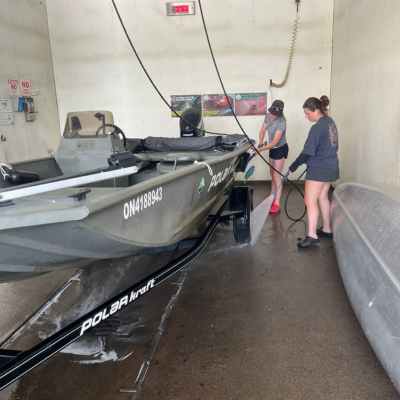
Cleaning, draining, and drying your boat and equipment is one of the most effective ways to prevent the spread of water soldier and other invasive species.
In Ontario, cleaning and draining your watercraft (motorized or non-motorized), trailer, vehicles entering the water, and other equipment is required by law before entering or leaving any waterbody:
- remove or open drain plugs to allow water to drain from the boat or boat equipment
- take reasonable precautions to remove all aquatic plants, animals and algae from any boat, boat equipment, vehicle or trailer
It’s even better if you can allow everything to dry completely in the sun or clean your boat from top to bottom with hot or pressurized water.
Learn how to identify and report water soldier
If you find water soldier or another invasive species in the wild, please contact the toll-free Invading Species Hotline at 1-800-563-7711, visit EDDMapS, or search for the ‘Lake Simcoe Invasive Species Project’ on iNaturalist.org to report a sighting.
Be sure to include clear photos and location coordinates of the sighting when making your report.
Safely manage small populations
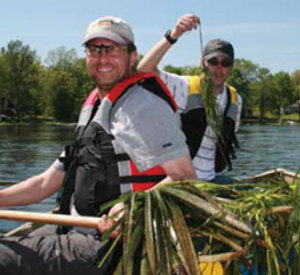
Plants and small populations can be controlled by hand pulling or with a rake. Gloves should always be worn when handling water soldier plants to prevent injury from the serrated edges on the leaves. The best time of year for hand pulling is in the early summer before water soldier produces turions (dormant winter buds), which can be released from the plant during these activities.
What to keep in mind when planning to manage water soldier: In Ontario, the beds of most waterbodies, including Lake Simcoe, are provincial Crown land. According to the Public Lands Act, a person can remove invasive aquatic plants, including water soldier, by mechanical means or by hand without a permit if you:
- are the waterfront property owner or conducting work on behalf of the property owner
- minimize the removal of native aquatic vegetation (e.g., wild rice)
- dispose of the plants/material you remove on dry land to prevent it from re-entering the water
- use, operate or store any wheeled or tracked machinery/equipment on dry land, or on a barge or vessel
- only use mechanical devices (e.g., rake, cutter bar) or your hands to remove plants, and do not dredge the bed of the waterbody
- do not carry out work during fish spawning season or during the time of other critical fish life stages, as set out in the In-water Work Timing Window Guidelines.
If you cannot meet all of the prescribed rules, or want to conduct control or removal activities outside of the timing window guidelines, you will need a work permit to remove water soldier. Learn more here. Please note that these guidelines do not apply to federal lands and water bodies (e.g., the Trent-Severn and Rideau Canal waterways), and certain isolated or offline water bodies on private lands.
Refer to Parks Canada’s See It, Pull It video to learn how to safely remove water soldier.
Other Ways You Can Help
Here are a few more simple ways you can help stop the spread:
- Do not include water soldier in water gardens or ponds. If you already have water soldier, dispose of it properly by removing it from the water and placing it on dry land greater than 30 meters where it cannot re-enter a waterbody or by sealing it in a bag and placing it in the garbage. Never compost or release it into natural areas.
- Never release plants or pets into natural waterbodies.