
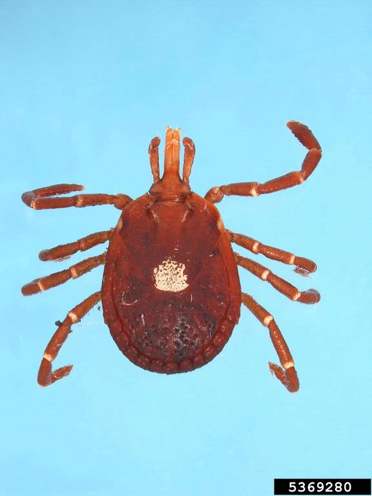
Identifying Lone Star tick
Lone star ticks can actively hunt their hosts by following vibrations, movement, and CO2 trails. All life stages of this tick bite humans, and they bite aggressively and deeply due to their long mouthparts, leaving a red and itchy lesion at the bite site within 48 hours of attachment.
Eggs:
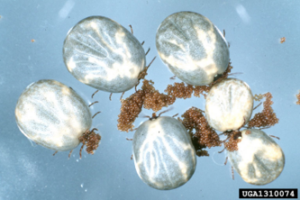
After a blood meal, adult female lone star ticks can lay approximately 5000 shiny, brown, oval-shaped eggs in a large dense cluster. These eggs are approximately the size of a period (<0.5 mm) making them difficult to see individually.
Larva:
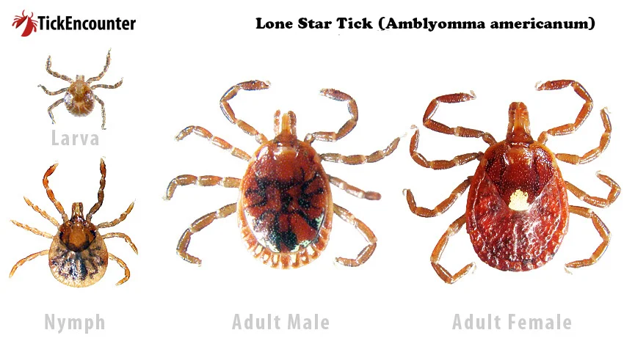
The larvae of the lone star tick are 1 mm wide (approximately the size of the head of a pin), have six legs, and range in colour from light tan to white, with brown legs. Lone star tick larvae are often mistaken for chiggers, skin-biting mites that are not known to transmit disease.
Nymph:
Lone star tick nymphs are larger than larvae, ranging in size from 1.5- 2.5 mm (approximately the size of a poppy seed). Unlike larvae, the nymphal stage possesses all eight legs and are a lighter brown than adults. At this stage they still do not have the distinctive white spot that characterizes the adult female lone star tick.
Adult:
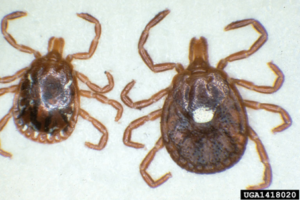
The adult female lone star tick, reddish-brown in colour, is the most easily distinguishable life stage due to the presence of a single solitary iridescent spot on its back which can range in colour from white to cream to gold/bronze. Similar to other “hard ticks” in the Ixodidae family, females are often larger than males. Male lone star ticks are generally 2-5 mm regardless of feeding state whereas females can range from 4-6 mm (unfed) to 16 mm or larger (when fully engorged after feeding). Although they do not possess the white spot on their backs, male lone star ticks can possess whitish streaks or spots on the margin of their bodies.
There are several native tick look-alikes:
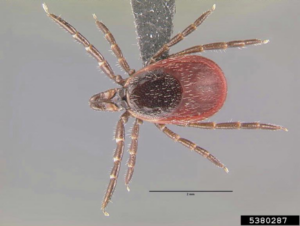
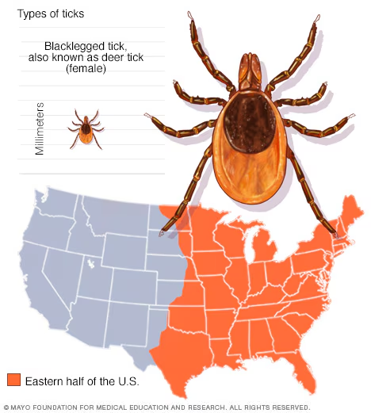
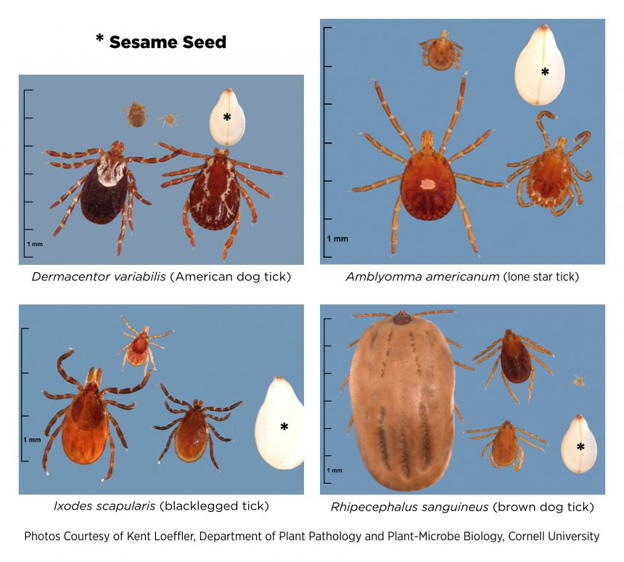
Black-legged/deer tick (Ixodes scapularis): Black-legged ticks, often called deer ticks, are widely distributed across central and eastern Canada, as well as the Eastern and Midwest United States (Public Health Agency of Canada, 2020; Mayo Clinic, 2023). Passive surveillance in Canada documented that approximately 1 in 6 black-legged ticks carry the bacteria that causes Lyme disease (Public Health Agency of Canada, 2021). These ticks are smaller than the lone star tick and adults are more teardrop shaped, compared to the circular LST adult. Adult female black-legged ticks lack the distinctive white dot that characterizes adult female LST; instead, females have a dark brown shield behind their head and a reddish-brown body.
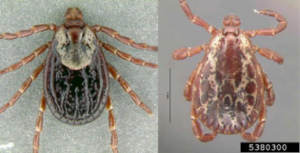
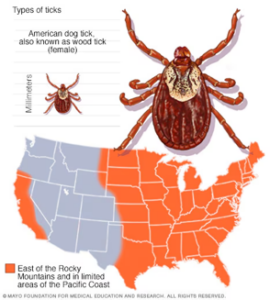
American dog tick (Dermacentor variabilis): American dog ticks can be found throughout the southern regions of Saskatchewan, Manitoba, Ontario, Quebec, and Nova Scotia, as well as in the Eastern United States and parts of Mexico; an isolated population also exists on the west coast of the United States (Nelder et al., 2022). While the American dog tick does not transmit the bacteria responsible for Lyme disease, they can transmit tularemia and Rocky Mountain spotted fever. American dog ticks can be distinguished from the lone star tick by their adult coloration and mouth pieces. Adult female American dog ticks are chestnut brown and do not have the distinctive white dorsal spot that characterizes the female LST but instead have a creamy white “harness” around the back of their heads (shield area). Male American dog ticks are dark brown and have faint creamy-beige lines that resemble lightning strikes across their backs, unlike the lighter colored and less decorated male lone star tick. American dog ticks also have shorter and more rounded mouth parts than the lone star tick.
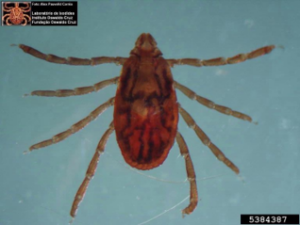
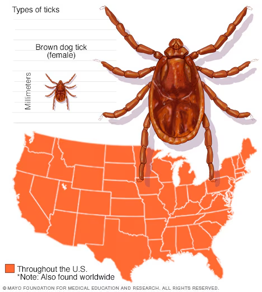
Brown dog tick (Rhipicephalus sanguineus): The brown dog tick is found worldwide wherever dogs occur, including throughout the United States and Canada. In Canada, this species is found exclusively indoors since it is associated with dog kennels, and dog-associated environments; it has not been found established in any outdoor natural environments in Canada (Public Health Agency, 2021). In humans, the brown dog tick can pass on the bacteria that causes Rocky Mountain spotted fever. In dogs, they can transmit the bacteria causing canine babesiosis, canine ehrlichiosis, and canine hepatozoonosis (Public Health Ontario, 2026). Unlike the LST, brown dog ticks are exclusively reddish brown with no distinctive white dot. Their bodies are also not as round, they have shorter and thicker mouthparts, and unlike the lone star tick, they are found exclusively indoors where they can complete their entire life cycle.
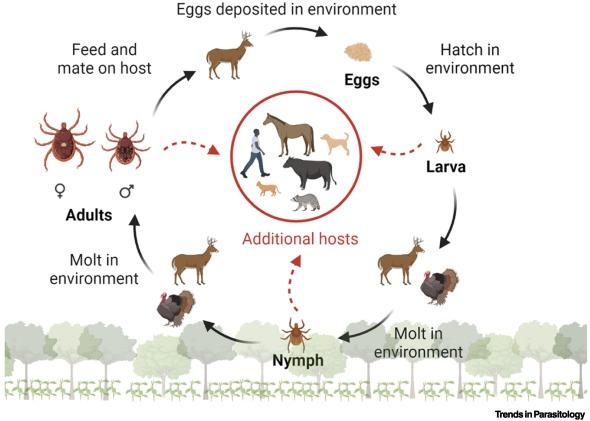
The lone star tick (LST) is a 3-host tick whose life cycle consists of four stages: egg, six-legged larvae, eight-legged nymph, and adult. It can take 2-3 years, depending on environmental conditions, for this tick to complete its life cycle from egg to adult. The LST life cycle starts in the spring when an adult female tick lays a large mass of approximately 5000 eggs in a sheltered location, such as mulch or ground litter, following a blood meal. In mid-June to July, depending on the local conditions, larvae will hatch from eggs in the following days to weeks. Larvae usually exhibit peak “questing”, hunting for a warm-blooded host, activity in June to August, but this varies geographically. Unlike the nymphal and adult stages, larvae do not carry diseases in their saliva, but their bites can still cause allergies (including Alpha-Gal or red meat allergy), irritation and itchy bumps. Lone star ticks are generalist feeders at all three life stages with larvae and nymphs feeding on small mammals, birds, white tailed deer and cattle, and adult ticks expanding their hosts to include deer, cattle, horses, feral pigs, dogs, sheep, and humans. This species is referred to as a three-host tick since each life cycle utilizes different hosts for feeding; LST larvae can feed on most birds or mammals, but adults prefer mammalian hosts. The larvae, once it has found a host through questing, will attach and feed for one to three days. Following feeding, the larvae will promptly drop off the host, digest the blood meal, and molt into a nymph, the next life stage. Nymphs experience two main activity periods; April-June for overwintering ticks and July-August for the new generation. The nymphal and adult stages are able to transmit diseases through their saliva including Heartland virus disease, Ehrlichiosis, Bourbon virus disease, Tularemia, and Southern tick-associated rash illness (STARI). Similar to larvae, nymphs will quest for a warm-blooded host and after feeding for one to three days, they will dislodge, digest, and molt into adult ticks. The adult life stage may overwinter and start to become active in January-February with peak activity in early summer. Following their molt from nymphs, adults seek out a mammalian host to feed and will mate on the host during their feeding. Males die soon after mating but fully engorged adult females will dislodge from the host and find a suitable environment, such as ground litter, to lay their eggs.
To summarize, nymph and adult ticks will emerge in early spring, remaining active throughout the summer; larval activity peaks later in the summer; unfed adult or nymphal stages will undergo a winter diapause, or rest period, to emerge in the spring and complete their 2-year life cycle (McClung et al., 2022).
Lone star ticks can be found in shady environments, often along roadsides and meadows or in grassy or shrubby habitats. They prefer dense understory vegetation in young deciduous second-growth forest and tend to be found in habitats associated with their keystone host for all life stages, the white-tailed deer (Nelder et al., 2019). This host serves the tick in two ways: as a preferred food source, and as a vehicle for transport within their ideal habitat. Factors affecting the abundance of LST include host availability, the temperature, number of daylight hours, ambient moisture in air, and the availability of their preferred vegetation type (Paddock & Yabsley, 2022). All life stages of the LST will “quest” by crawling up the to the tips of low growing vegetation to wait for, or actively pursue, a passing host.
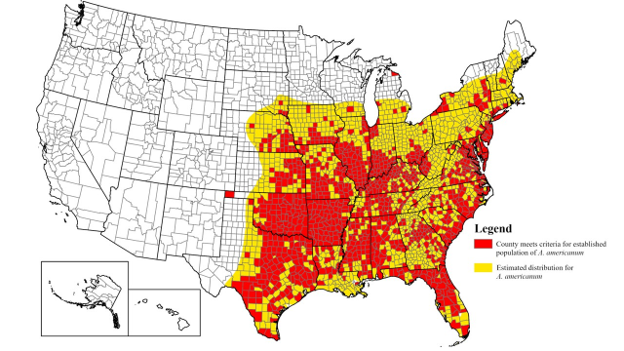
The lone star tick’s native range comprises the southeastern and southcentral U.S. but since the mid 1900s, due to a variety of factors including warming climate (warmer and shorter winters), more woodlots, and increased dispersal of hosts, including the white-tailed deer, the lone star tick has experienced an expansion in range (Fowler et al., 2022). Today the lone star tick has expanded its range to include the Northeast, South, and Midwest United States (see map below). In Canada, LST are known as adventitious ticks, since they not currently established, but have been found in the southern regions of Ontario, Alberta, Manitoba, Nova Scotia, Quebec, and Saskatchewan, with the first documented LST in Canada found in Aweme, Manitoba in 1912 (Nelder et al., 2019). It is thought these ticks arrive in Canada by hitchhiking on wildlife and human hosts, including migrating birds and travellers returning from the U.S.
Ecological
Climate change is influencing the lone star tick’s range, their interaction with hosts, their abundance, and their seasonal activity patterns. A warming climate is allowing the LST to continue their range expansion into new territory, and may also extend their active season, influencing not only the availability and abundance of their host species, but also important interactions between vectors, hosts, and pathogens (Molaei et al., 2019). The lone star tick’s aggressive range expansion can be credited in part to an abundant white-tailed deer (reproductive host) population, warming climate, and the tick’s ability to rapidly adapt to new environments (genetic plasticity). It is important to consider how the range expansion of this tick will affect the ecology of the environments it invades. Initially only considered a nuisance biter, the LST is increasingly recognized as one of the most important tick vectors in North America, their ability to bite and infect humans, domestic animals, and livestock, contributing to their role as an important emerging public health threat and ecosystem disturber (Springer et al., 2015). Ecologically, the range expansion of the lone star tick could increase, overlap, and encroach on the range of the native black legged tick, potentially competing with native tick populations and changing the tick community composition, modifying food webs, and changing the tickborne disease landscape by introducing new pathogens.
Economic
There are many economic impacts associated with the rapid and aggressive range expansion of the lone star tick.
Firstly, as an important ectoparasite of livestock, including cattle, the continued spread of the lone star tick could lead to economic losses in the livestock and agricultural industries. LST infestations on cattle lead to blood loss, increased stress, and decreased foraging efficiency, contributing to a reduced weight. This can lead to a reduced livestock price since an average of 40 attached adult female ticks can reduce weight gain in stocker cattle by approximately $40 per animal, and tick bites can decrease the value of the leather produced (Ervin et al., 1987).
Secondly, increased tick-human interactions and bites will lead to higher medical costs and act as an additional burden on the healthcare system. The LST can transmit a variety of illnesses, and treating these tick-borne diseases results in direct medical costs, such as doctor visits, antibiotic prescriptions, and laboratory testing. Increased antibiotic use could also further exacerbate the escalating antibiotic resistance crisis. The tick’s transmission of alpha-gal syndrome, the severe allergy to mammalian meat and products, can also result in increased medical and food costs for affected individuals requiring specialized diets, in addition to reducing regional livestock economies.
Lastly, the aggressive hunting nature of the lone star tick can impact recreation and outdoor tourism activities. In areas of infestations, public health warnings about tick bites and tickborne illnesses may deter outdoor tourism and impact the local economy. Additionally, the management costs associated with tick control, including controlled burns, vegetation management, and chemical treatments, must also be considered.
Social
The lone star tick has the potential to cause social harm through its role as an important vector of disease. Although LST do not transmit Borrelia burgdorferi, the primary causative agent of Lyme disease in North America, they are associated with several human diseases and medical conditions. These diseases include tularemia (bacterium Francisella tularensis), ehrlichiosis (bacteria from the genus Ehrlichia), Heartland virus disease, southern tick-associated rash illness, or STARI, (unknown pathogen but presents symptoms similar to early Lyme disease), and Bourbon virus disease (Molaei et al., 2019). The lone star tick is also associated with the transmission of red meat allergy, or alpha-gal syndrome, a serious and potentially life-threatening allergy to the carbohydrate alpha-gal, which is naturally produced in the bodies of non-human mammals. Following a lone star tick bite, in which the tick transmits alpha-gal through its saliva, allergy symptoms occur after that person consumes red meat or other mammal derived products such as dairy. As a result, it is recommended for people with alpha-gal syndrome to stop eating red meat products, including beef, pork, lamb, venison, or rabbit, dairy products, and non-food items, including medicines, that contain mammal derived products (CDC, 2024). Additionally, even in the absence of disease transmission, LST bites can be highly irritating, and combined with a fear of disease transmission, may dissuade some from venturing out in nature.