

What is the Black Ash Community Action Network?
As part of a new initiative to raise awareness about the impacts of the emerald ash borer (EAB) on ash tree populations in Ontario, the Invasive Species Centre (ISC) — with funding and support from the Ministry of the Environment, Conservation and Parks (MECP) — is coordinating a volunteer network from across the province to collect black ash seeds for long-term preservation at the National Tree Seed Centre (NTSC) in New Brunswick. This work is being carried out in partnership with Natural Resources Canada (NRCan), Ontario Forest Research Institute (OFRI), and Forest Gene Conservation Association (FGCA).
The Black Ash Community Action Network (BACAN) is a collaborative, province-wide initiative that demonstrates the ISC’s commitment to supporting government-led actions to meet the goals outlined in the Ontario Government Response Statement for black ash recovery.
To register to become a volunteer seed collector, please complete and submit the registration form.
On this Page You'll Find:
What's at risk?
Black ash (Fraxinus nigra; Ojibwe: baapaagimaak) is more than just a hardwood tree — it’s considered a keystone and climax species in many wetland and lowland ecosystems across North America, where it dominates the canopy and provides essential ecological functions. It is also a culturally significant species to Indigenous peoples, with its wood holding commercial value as well.
The combined pressure of habitat loss, climate change, and the ongoing threat of EAB has contributed to significant black ash mortalities. The species was classified as endangered on the Species at Risk in Ontario (SARO) list in 2022, due to the projected decline of > 70% of black ash over the next 100 years, resulting from the combined effects of EAB infestations and climate change. It was previously believed that black ash trees at the northernmost extent of their range were protected from EAB invasion due to the insect’s inability to survive winter temperatures below -26°C and -35°C. However, recent findings show that EAB can withstand extreme cold as low as -50°C. Combined with warming winters, this suggests that the northern expansion of the invasive insect may no longer be limited by cold temperature – putting black ash populations in the northernmost parts of their range at risk of invasion. With as high as 25% of the global population occurring here in Ontario, the province plays a critical role in the conservation and recovery of this species.

Black ash typically grows in swampy, seasonally flooded areas, such as fens, riparian forests, and shorelines where few other tree species can thrive, though it can also occur in moist microsites within upland habitats. Its presence supports a rich diversity of plant and animal life, helping to stabilize soil, regulate water flow, and maintain wetland health.
The loss of black ash from these ecosystems could have cascading effects, altering water dynamics, increasing erosion, and reducing habitat quality for numerous wetland-dependent species. The native Canadian Sphinx Moth (Sphinx canadensis) for example, is believed to rely almost exclusively on black ash for larval development and survival, highlighting the fragility of interspecific species interactions and the broader ecological consequences that can arise when a single species is threatened. Additionally, the loss of black ash due to EAB can have lasting impacts on habitats where the species is dominant, creating conditions for habitat conversion and increasing the risk of invasion by other invasive species.
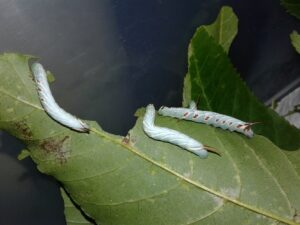
Sphinx canadensis feeding on black ash foliage. Photo by Alexandre Laberge, via Breedingbutterflies.com
Valued for its flexibility and strength, black ash has been used for thousands of years by the Anishinaabeg, Haudenosaunee, Wabanaki, Ho-Chunk, and Menominee peoples for a wide range of purposes, including basketry, tool handles, snowshoe and cradle frameworks, fuelwood, and wigwam construction. For many Indigenous communities across Ontario and beyond, black ash is deeply tied to cultural identity, traditional knowledge, and intergenerational practices.
Historically, black ash wood has been valued for its strength and workability, making it ideal for tool handles, furniture, and various handcrafted products. Its growth conditions produce strongly ring-porous yet flexible wood, well-suited for items such as baskets, snowshoe frames, canoe ribs, and more. While not as commercially widespread as white or green ash, black ash has played an important role in local economies—particularly among craftspeople and small woodlot operators.
Amid the ongoing threat posed by EAB, the value of black ash extends beyond its ecological and cultural importance to its genetic potential. While EAB has devastated ash populations across North America, a small number of ash trees—often referred to as “lingering ash”—have demonstrated an ability to survive even in areas of severe infestation. These trees may possess natural tolerance or resistance to the invasive insect, offering a potential key to the species’ long-term survival. As such, lingering ash are the focus of ongoing research and seed conservation efforts. Their unique traits could not only support black ash recovery but also provide valuable insights for enhancing the resilience of broader forest ecosystems.
Our initiative supports efforts to identify, map, and collect seeds from black ash populations — especially those that have survived past EAB infestations. By preserving this genetic material, we are complementing existing efforts to build a foundation for long-term recovery and potential breeding for resistance.
The Primary Threat: Emerald ash borer
Emerald ash borer (Agrilus planipennis; EAB) is a highly destructive, invasive beetle native to Asia responsible for the deaths of millions of ash trees across North America. For more information, visit the EAB species profile.
All native ash tree species in Ontario are vulnerable to EAB, but among them, black ash is particularly at risk due to its limited distribution, slow regeneration, and specialized habitat.
How to Identify Black Ash
Black ash is one of five native ash species found in Ontario, along with white ash (Fraxinus americana), green/red ash (Fraxinus pennsylvanica), blue ash (Fraxinus quadrangulata), and pumpkin ash (Fraxinus profunda).
The following ID features, when used together, can help distinguish black ash from other ash species.
Leaves
Opposite compound leaves – composed of 7-11 stalkless leaflets attached directly to the central stem. Leaf is hairless except for dense tufts of rusty hairs at the base of the leaflets.
Tip to remember: black stays stacked.
Bark
Bark on young trees is corky and soft and becomes scaly with age. Bark scales are easily rubbed off and reveal a pale orange/tan underside.
Tip to remember: black flakes fast.
Twigs
Terminal bud (at the tip of the twig) is dark brown to black and sharply pointed. Gap present between terminal bud and first pair of opposite lateral buds.
Tip to remember: black buds slack.
Seeds
Samaras with wings that extend down to the base of the seed, giving them a blunt or rounded appearance at both ends.
Tip to remember: black wings cling.
Tree Form
Like all ash species, black ash has an opposite branching pattern. This can be used to quickly distinguish ash trees from other tree species. Be sure to confirm using the other ID features above, as other tree species also share this trait.
Tip to remember: ash branches match.
Get Involved: Help Us Collect Black Ash Seeds
Are you passionate about protecting the natural environment and ready to make a difference?
This is YOUR opportunity to leave a meaningful and lasting impact on the future of an endangered species. By joining our growing network of citizen scientists, landowners, Indigenous community members, naturalists, and forestry professionals, you can play a direct role in safeguarding black ash for generations to come.
Seed collection is one of the most powerful conservation actions we can take right now to preserve the genetic legacy of this iconic tree.
Why Now?
The next major bumper crop for black ash — when trees produce the largest volume of viable seeds — is predicted to occur in 2026 or 2027. These events are rare and critical windows of opportunity.
By organizing, educating, and mobilizing now, we’ll be ready to act at scale when that moment arrives. In the meantime, we are also scouting and mapping black ash to increase our understanding of where it occurs on the landscape.
Ready to help?
Sign up to volunteer by completing the registration form
Join the iNaturalist project and help us map black ash: Ontario Black Ash Inventory
Attend a workshop or training session — subscribe to our newsletter to stay current with ISC events!
*DISCLAIMER: To participate in black ash seed collection as part of this initiative, you MUST be registered as a volunteer with the Invasive Species Centre (ISC) by completing and submitting this form. Black ash is a protected species under provincial legislation and as such, volunteer registration is required to legally collect seed under the conditional exemption outlined in section 17.1 of Ontario Regulation 242/08 (General) of the Endangered Species Act (ESA). ISC cannot accept seed submissions from individuals or organizations that are not registered.

