
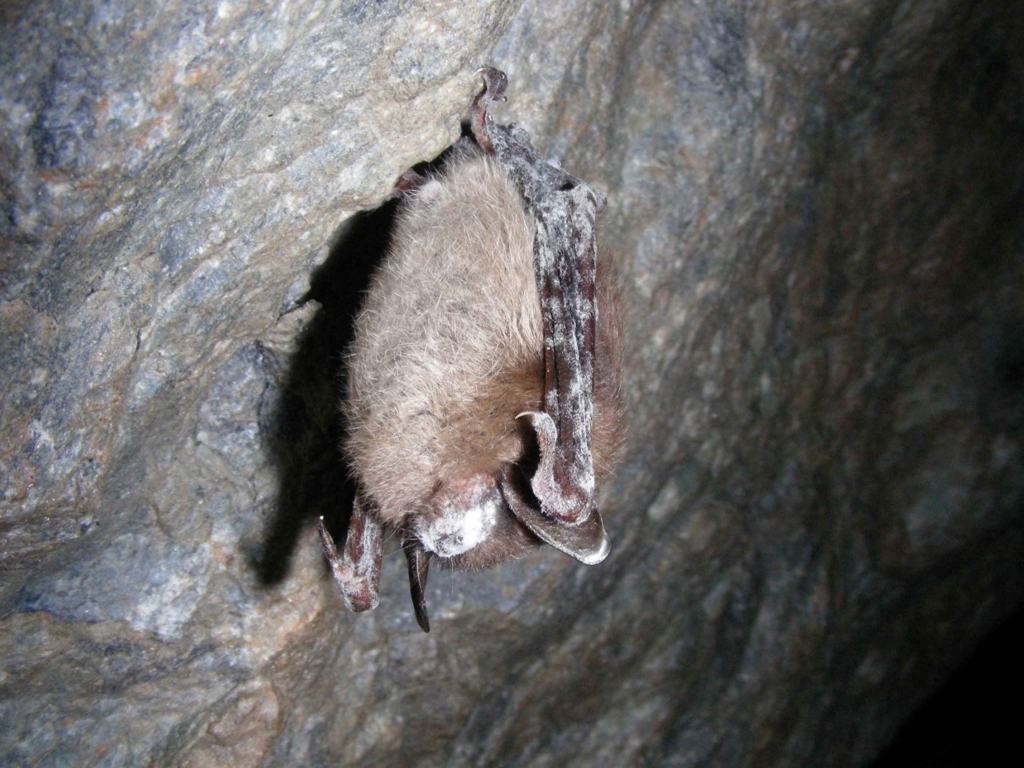
White-nose syndrome is a disease caused by the invasive fungi Pseudogymnoascus destructans. P. destructans are classified as one of two mating types (MAT1-1 and MAT1-2) and are capable of both asexual and sexual reproduction, the latter requiring the interaction between individuals of opposing mating types (Isidoro-Ayza et al., 2024). As only the MAT1-1 type has been observed in North America, this species likely relies exclusively on asexual reproduction in this region. The optimal conditions for growth of these fungi are temperatures between 12-16˚C and high levels of relative humidity. Bats that are living in areas with these conditions are more likely to contract WNS.
The colonization and infection of bat skin by this pathogen progresses through four phases. These phases include noninvasive colonization, early non-damaging invasion, late damaging invasion, and death or pathogen clearance/resolution (Isidoro-Ayza et al., 2024).
In the first stage, noninvasive colonization, the conidia of P. destructans become attached to the bat’s skin, then, when conditions are right, like during torpor, the conidia germinate. This is when they form a germ tube and hyphae, which allow the fungi to breach the skin barrier. These processes are halted whenever the bat’s skin temperature is higher than 20°C.
In the next stage, early non-damaging invasion, the bat’s skin cells are invaded, which can happen whether the bat is in torpor or not. During torpor, there would be active invasion, with the preferred temperature and dormant host cells; at all other times, passive invasion occurs.
During the third phase, late damaging invasion, the hyphae form clusters inside of the skin, forming the lesions that are often used to diagnose a bat with WNS. The impacts on the bats’ wing membranes also cause reduced levels of bicarbonate and increased levels of potassium in the blood, increased metabolic rates, and dehydration. These changes are what cause more frequent arousals in infected bats, which result in worsening symptoms, depleted fat storage, starvation, and death.
Lastly, in the final phase, bats that survive WNS until the end of hibernation will experience immune reconstitution inflammatory syndrome (IRIS), which can include extreme damage to wing tissues, pathology, and systemic shock. Those that remain after IRIS eventually clear out the fungus, form new epithelium, and shed the debris and degenerated cells, with scar tissue replacing any open spaces in their skin (Isidoro-Ayza et al., 2024).
Diagnosis of WNS involves identification of white fungal growth on the snout of the affected bat, as well as other common symptoms such as lesions occurring on the ears and/or wings (Cornell Wildlife Health Lab, 2026). Following visual detection, and a fungal culture, histological analysis and PCR testing are used to confirm positive diagnosis of the disease.
The bat species that are vulnerable to WNS are insectivores that hibernate in the winter to escape the cold weather and food scarcity (Isidoro-Ayza et al., 2024). During their periods of inactivity, called torpor, which can last between 2-3 weeks at a time, their body temperatures drop to approximately 1 to 16 °C and their metabolism is dormant. Bats rely on this period of torpor to protect them from pathogens since most bacterial pathogens infecting mammals cannot replicate below 5°C. This does not, however, protect the bats from WNS as the infecting pathogen thrives in cooler environments.
There are 12 different bat species across North America that have experienced the symptoms of WNS, as shown below. Species found in Canada are underlined:
- Big brown bat (Eptesicus fuscus)
- Western long-eared bat (Myotis evotis)
- Gray bat (Myotis grisescens) *
- Eastern small-footed bat (Myotis leibii)
- Little brown bat (Myotis lucifugus)*
- Northern long-eared bat (Myotis septentrionalis) *
- Indiana bat (Myotis sodalist) *
- Fringed bat (Myotis thysanodes)
- Cave bat (Myotis velifer)
- Long-legged bat (Myotis volans)
- Yuma bat (Myotis yumanensis)
- Tricolored bat (Perimyotis subflavus) *
*Endangered
(White-Nose Syndrome Response Team, N.D.a; WCSC, 2023)
However, there are some North American species of bat which appear to be slightly less susceptible to WNS. For example, one study in Wisconsin showed that the big brown bat (Eptesicus fuscus) only experienced 38% WNS associated population decline compared to a 95% decline in the little brown bat (Myotis lucifugus) populations (Wray et al., 2024).
Evidence of WNS can be shown through both behavioral and physical changes in affected bats. The most obvious physical symptom can be found by observing the bat’s snout, ears, and wings, which will appear to be white and fuzzy. There may also be white fungus rings on the bat’s face (Ministry of Natural Resources, 2025). The growths on the snout, ears, and wings of hibernating bats should be approximately 1-3 mm in diameter, with a black center (Garcês and Pires, 2024). Additionally, their wings may show other changes, such as splitting, loss of pigment, or dryness, all of which can lead to increased water loss.
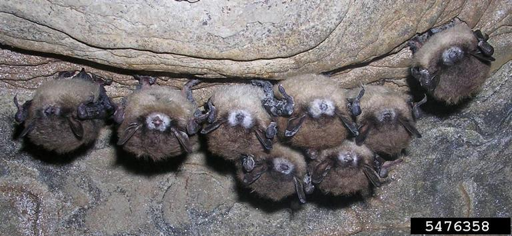
In terms of behavioral changes, bats are normally nocturnal, therefore observing a bat flying outside during the day, in below-freezing temperatures, could indicate that the bat has contracted WNS (Ministry of Natural Resources, 2025; Cornell Wildlife Health Lab, 2026). Additionally, before bats enter hibernation, they build fat stores in their bodies, then conserve their metabolic energy while in hibernation to survive this period (Reeder et al., 2012). While hibernating, their fat stores will be their only source of energy. Since torpor periods are supposed to last for days or weeks at a time, when the bats do have arousal periods, their body temperature and metabolic rate greatly increase, and they use up most of their stored fat (Reeder et al., 2012). Since WNS increases the frequency of these arousals, the bats tend to use these fat stores too quickly, often causing them to die of starvation (NPS, 2017).
Other causes of death for the bats that do not survive WNS are thought to be loss of fluids and electrolytes, and/or starvation due to wing damage which eliminates their ability to catch and feed on flying insects (Cornell Wildlife Health Lab, 2026).
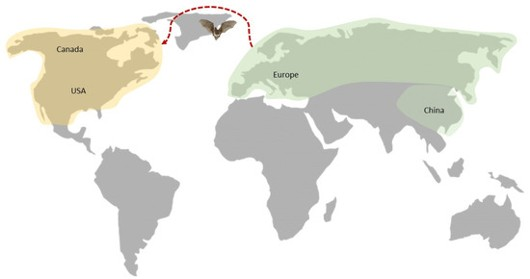
In addition to Canada and the Unites States, the fungus responsible for WNS is present throughout 19 countries in Europe and has also been detected in China. The pathogen’s native range is thought to be Europe and Asia (Garcês and Pires, 2024). It is still unknown how the pathogen was introduced to North America; however, it is most likely linked to human-mediated dispersal through contaminated clothes or equipment (especially materials exposed to caves by cave explorers or tourists).
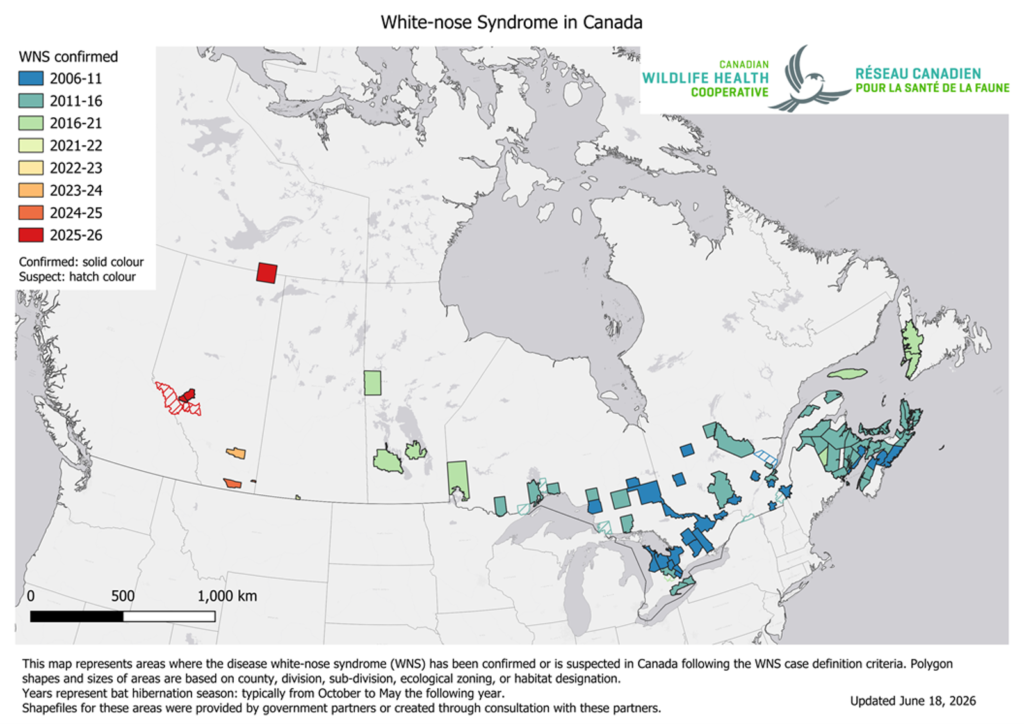
WNS has become widespread across North America since its introduction in 2006. The primary method of distribution among bats is direct physical contact with an infected individual (NPS, 2017). WNS can also be spread indirectly by bats encountering the fungus in the places that they roost, including where they go to hibernate. Part of WNS’s rapid spread throughout the continent is thought to be because of human activities in and around caves (Ministry of Natural Resources, 2025). When entering caves, humans can pick up the fungus on their gear, shoes, or even clothes, then transport it to other caves on their next trip (NPS, 2017).
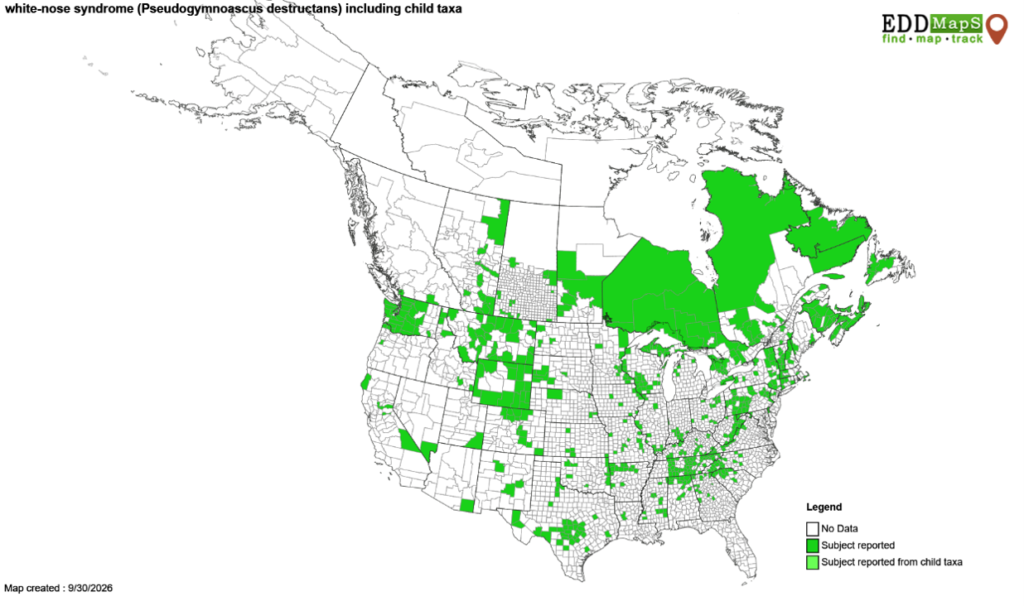
A map shown below from the Canadian Wildlife Health Cooperative displays historical and current detections of the disease.
Economic
Bats offer a valuable ecosystem service simply by consuming insects! Moths are usually their preferred prey, some of which produce caterpillars that eat crops, including corn earworms and black cutworms (PennState Extension, 2024). When bats aren’t around to consume these pests, crop revenue can decrease as a result of both lower crop yields and increased insecticide use. In the United States, the service bats provide of maintaining insect populations is valued at $3.7 billion every year (Parks Canada, 2025). While Canadian bats are mainly insectivores, in other areas of the world, bats are also responsible for seed distribution and pollination (CWF, N.D.). Tropical species are credited with pollinating at least six different foods, including mangoes and bananas, which many people enjoy daily (NPS, 2022; Parks Canada, 2025). With the spread of WNS, bat populations may continue to decrease, heavily impacting crops and increasing costs for farmers around the world.
Social
Some bat species also provide us with social benefits that we might not even know about! For example, the little brown bat, Myotis lucifugus, feeds on many different small insects, and can consume over 1000 of them in one hour (Hinterland Who’s Who, N.D.). These can include mosquitoes, midges, moths, mayflies, and a large variety of other flying insects. Mosquitoes tend to carry a variety of diseases that threaten human health. Without bats, more of these diseases have the potential to spread to humans.
Ecological
As a result of the spread of WNS across Canada, there are three bat species that have already been designated as endangered under Schedule I of the Species at Risk Act (ECCC, 2024). Changes must be made to help protect these vulnerable populations before they become extirpated, which would have long-lasting impacts on the stability of Canadian ecosystems. Infected populations have also been reported to have long recovery periods due to their naturally slow fecundity and additional threats (Garcês and Pires, 2024).
Of all mammals, bats make up 25% of known species; there are 1400 bat species around the world, and 19 of them are found in Canada (Contos, 2023). Bats are seen as vital components of both forest and wetland ecosystems, acting as insect predators and working to maintain the delicate balance between organisms. Losing these bat species will have cascading impacts throughout our ecosystems, putting our rich biodiversity at risk.
Prevent
Human interference is at least partially responsible for the spread of WNS between populations. Continuous outreach and education efforts should be prioritized to help prevent WNS from spreading to more populations.
The Government of Ontario recommends avoiding any non-commercial caves and vacant mines. Additionally, no caves or mines should be entered while bats are in hibernation (Ministry of Natural Resources, 2025). However, if you must enter caves, you should thoroughly examine and disinfect your shoes, clothes, and equipment to minimize the chance of spreading the pathogen. For instructions on proper methods of disinfection, the Government of Ontario recommends the CWHC’s decontamination protocols. Additionally, if you’re planning to enter caves or mines in other provinces/territories or countries that are WNS negative, you should not use any equipment that has been used in Ontario caves or mines (Ministry of Natural Resources, 2025).
The Canadian Wildlife Health Cooperative created a national management plan with further ideas for prevention. They highlight the importance of increasing accessible information on the pathogen to spread awareness about WNS, as well as creating more tools for public reporting of WNS sightings (Canada’s Inter-Agency White Nose Syndrome Committee, 2015).
Response and Control
Vaccines are being explored as a potential tool against the spread of P. destructans. As a result of working since 2015, scientists have developed an oral vaccine against the pathogen, and are continuing to explore alternative methods of application, such as applying the vaccine to the skin of bats to be consumed during grooming (National Wildlife Health Center, 2026a). Not only could this assist in lowering the risk of WNS spread, but it could also increase the potential for infected bats to survive the disease. It is important to note that the vaccine is likely to be most effective when it can be administered before exposure or quickly after a population is exposed for the first time (National Wildlife Health Center, 2026a).
Additional treatment measures currently being researched include antifungal chemicals and potential modifications that can be made to bat hibernation areas (Cornell Wildlife Health Lab, 2026).
The Canadian and Ontario governments have taken several steps towards preventing further spread of WNS.
The Wildlife Section of the Species Conservation Policy Branch within Ontario’s Ministry of Natural Resources and Forestry published a response plan for White-nose syndrome in 2015. The purpose of this plan was to provide steps for the government, stakeholders, and the public to take against WNS (Ministry of Natural Resources and Forestry, 2015). This included steps towards standardizing management practices, consistent data collection, and result sharing.
Three of the affected bat species in Canada are listed as endangered under Schedule 1 of the Species at Risk Act (SARA). A corresponding recovery strategy was published in 2018 by Environment and Climate Change Canada. The objectives in affected areas were to maintain or restore bat ranges to what they were prior to WNS, change declining populations to stable or increasing trends, and help populations become self-sustaining (ECCC, 2018). For any areas not yet affected by WNS, maintaining stable or increasing populations is the top priority.
Ontario’s Ministry of the Environment, Conservation and Parks published a similar recovery strategy in 2019 for the same three bat species, as all three are also listed as endangered on the Species at Risk in Ontario (SARO) list. This strategy notes that Ontario is adopting the prior recovery strategy from ECCC, with additional notes on aspects such as critical habitat (Humphrey and Fotherby, 2019).
Customs Notice 24-04: Import Prohibition on Bat Guano
This notice emphasizes that any form of bat guano entering the country is prohibited, unless it’s being used for scientific research (Canada Border Services Agency, 2024). This notice falls under the CFIA’s Health of Animals Regulations, Section 40, and Fertilizers Regulations, Section 2.1. This helps to prevent P. destructans from entering the country, in addition to 50 other pathogens found in bat guano (Canada Border Services Agency, 2024).
Customs Notice 26-08: Import permits required for bat (Chiroptera) specimens
This notice highlights the declarations required for importing bat specimens into Canada, as well as the mandatory CFIA import permit (Canada Border Services Agency, 2026). The permit is required under the CFIA’s Health of Animals Regulations within Part II, Importation. These restrictions are applicable to all bats within the Chiroptera Order, no matter what form they arrive in, from decorations to parts of a skeleton (Canada Border Services Agency, 2026).