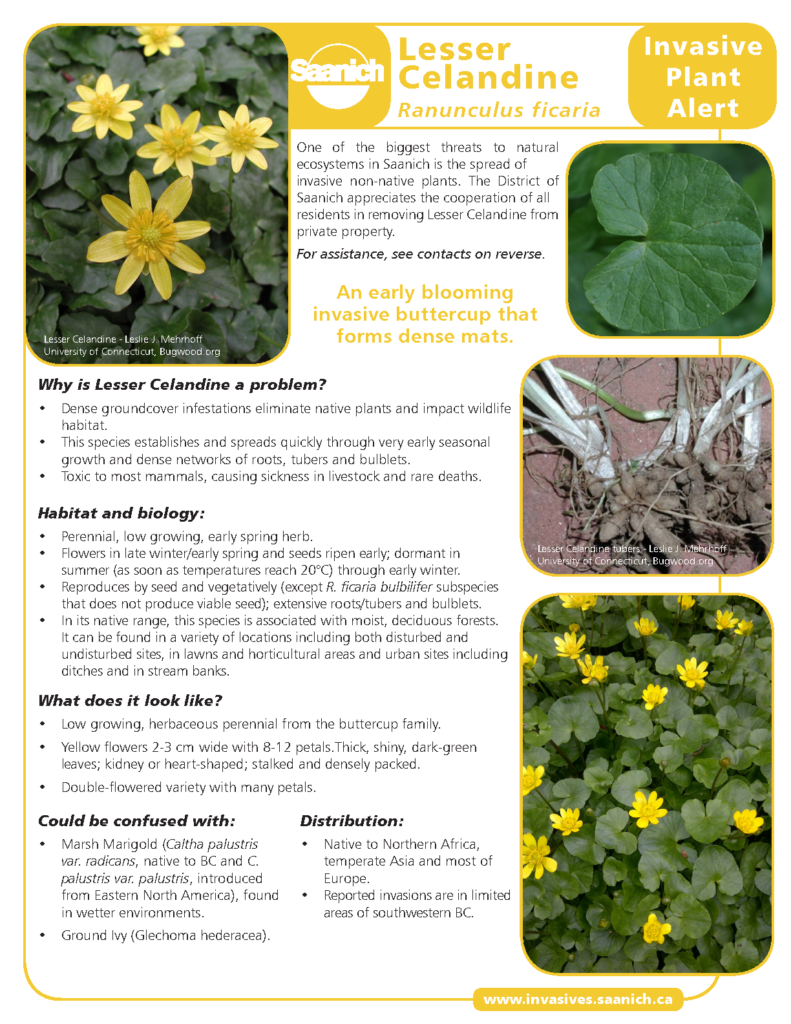
- Height: Lesser celandine is a low-growing herbaceous spring ephemeral that can reach heights of 10 to 30cm (0.1 – 0.3m).
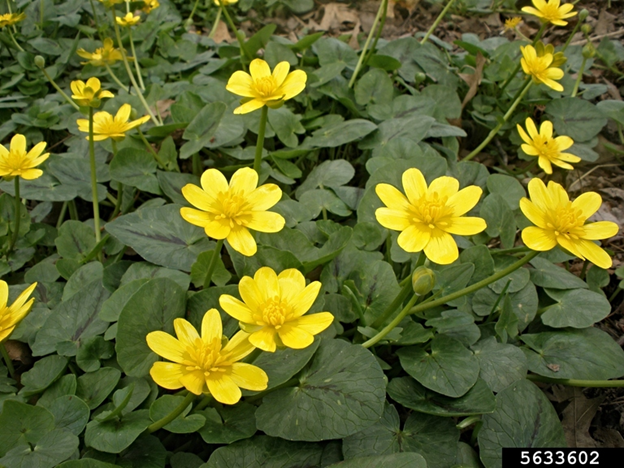
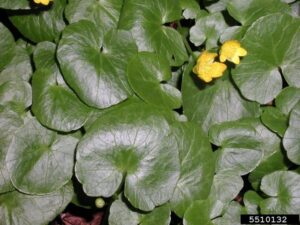
- Leaves and stems: Dark green kidney- to heart-shaped leaves grow in dense basal rosettes along short weak stalks. Leaves vary in size but typically range from 0.4-1cm long. New plants emerge as 1 to 2 tiny leaves sprouting from the soil in late winter or early spring. After flowering, stems will produce white bulb-like structures (bulbils) from an axillary bud.
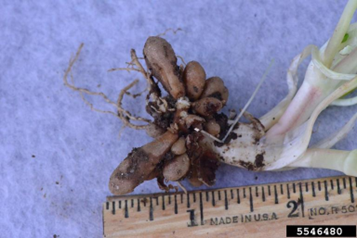
- Roots: Lesser celandine develop a dense mat of fibrous adventitious roots and small, pale potato-like tubers from a terminal bud. The majority of the year is spent underground, before plants emerge from tubers the following spring.
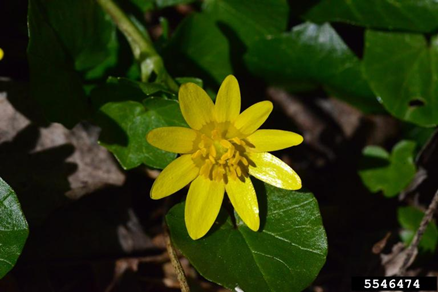
- Flowers: Flowers are glossy and bright yellow with 8 to 12 long narrow petals on a single stalk. They’re about 2 to 6cm wide with a darker yellow centre. The undersides of flowers have 3 to 4 green sepals. Flowers typically bloom between late March through early May, completing their lifecycle by June. Flowers are nyctinastic, meaning they close overnight and when hit by rain.
- Seeds and reproduction: While lesser celandine can produce up to 70 viable seeds per plant, reproduction primarily occurs through the vegetative spread of bulbils produced by stems after flowering and underground tubers. Bulbils are spread by flowing water after being shed, however they may also be moved by animals, people, vehicles, and other equipment. Tubers may be spread by erosion or through the transport or disturbance of soil.
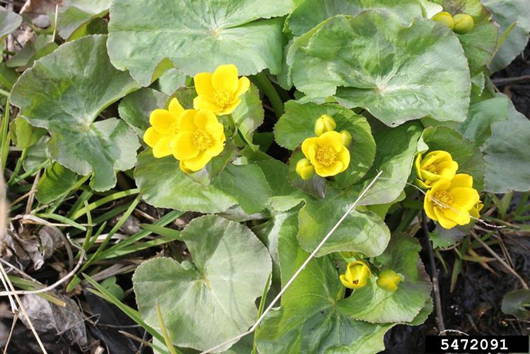
Lesser celandine may be mistaken for marsh marigold, which is a common native look-a-like species. Both plants thrive in moist, waterlogged environments where they are found along streams, marshes, and ponds. Marsh marigolds can be readily distinguished by their sharp finely toothed leaf margins, thicker robust stems, and large, rounded flowers with 5 to 9 petals. Lesser celandines have smooth or rounded leaf margins, with weaker stems that tend to hang limply, and flowers with 8 to 12 elongate petals. Lesser celandine also tends to grow in dense patches while marsh marigold grows as an individual plant in very wet locations. Marsh marigolds do not produce starchy tubers or bulbils.
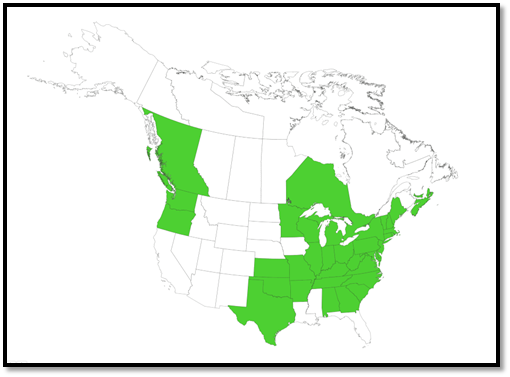
Lesser celandine can survive in a wide range of conditions and is tolerant of most soil types, although this invasive prefers moist forested floodplains adjacent to water sources that allow it to more readily spread its bulbils. Here flowers will infest forest floors, eventually spreading upwards to higher ground. In its invasive range, lesser celandine has spread across Canada with populations recorded in Atlantic Canada, Ontario, Quebec, and British Columbia.
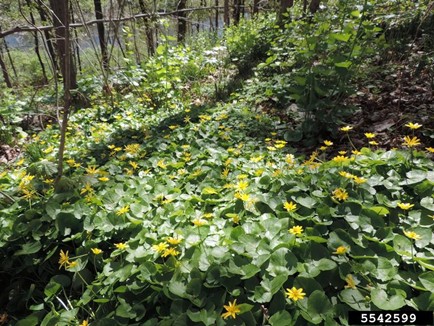
With its propensity to quickly spread without human or animal aided dispersal, lesser celandines threaten biodiversity as they form dense ephemeral monocultures along already at-risk wetland habitats. Bulbils in particular are able to spread long distances along waterways and during flooding events, leading to less reliance on animals for natural dispersal. Higher colonization capacity has also been associated with short generation times, as lesser celandines are able to rapidly occupy forest floors, establishing dense colonies that prevent native species from completing their lifecycles in the spring season. Following senescence in June, this invasive flower leaves behind large patches of bare earth that are readily colonized by other invasive plants and weed species, further degrading at-risk wetland habitats and disrupting resource availability. The loss of native species in turn harms wildlife dependant on them for both food and shelter. Furthermore, the fresh leaves of lesser celandines are considered toxic to most mammals, causing sickness in both wildlife and livestock if ingested.
Prevention is the key to preventing further introduction and infestations of this highly invasive plant. Do not purchase, plant, or transplant lesser celandine and ensure soil is not contaminated.
Mechanical Control:
The key to managing lesser celandine populations is identifying colonies before extensive infestations occur. Due to their short generation times, these invasive plants have a brief window to both identify and remove plants before seed, bulbil, and tuber dispersal occurs. The mechanical control of lesser celandine is a multi-year effort, requiring excessive removal of soil to target and remove all tubers along with the rest of the plant. Prevention is the most practical and cost-effective defence against lesser celandine establishment.
Physical removal should be completed in spring while the plants are still flowering and soil is still moist, to prevent seeds and bulbils from forming. It is essential to remove as much of the root system as possible to prevent regrowth – if the entire root and tuber system is not removed then contaminated soil will simply worsen the spread. All plant parts must be sealed in bags for disposal. Dispose of pulled and cut invasive plants in black garbage bags and let them sit in the sun on a hard surface for at least a week. Don’t discard invasive plants in the compost or natural areas as this may lead to further spread. When managing larger sites, manual pulling and digging may be less efficient, as it becomes challenging to thoroughly eradicate all existing tubers. Mowing is not an effective control method for lesser celandine as tubers will remain unaffected.
Chemical Control:
Herbicide applications are the most effective method of lesser celandine control; however larger populations will require more than a single application as underground tubers may survive. In Ontario, herbicide use, storage, and disposal is regulated under the Pesticides Act. Herbicides must be applied in accordance with all label directions. Lesser celandine can be effectively managed by using the non-selective, post-emergent systemic herbicide glyphosate. Anyone using a pesticide is responsible for complying with all federal and provincial legislation. Most non-domestic (i.e. commercial, restricted etc.) herbicides can only be applied by licensed exterminators. For more information, refer to the Ontario Pesticides Act and Ontario Regulation 63/09 (available on www.e-laws.gov.on.ca), or contact the Ontario Ministry of the Environment (http://www.ene.gov.on.ca/environment).
Similar to mechanical removal, the herbicide application window for lesser celandine is quite brief. Treatment should be applied between late-March to early-May, preferably before the end of April to minimize potential application to native plants. Glyphosate is a non-selective herbicide which means it will kill most green plants it comes into contact with, making consideration of native species an important part of developing a treatment strategy.
Biocontrol:
There are currently no confirmed biocontrol options available for lesser celandine.