
A Near Miss: How rapid response and coordinated efforts ensured effective eradication of Asian longhorned beetle in Ontario
Written by: Adam Gouge, Invasive Species Centre
Asian longhorned beetle (ALB) (Anoplophora glabripennis), is a species of voracious tree feeding insect native to parts of Asia, with the potential to cause large scale damage to populations of native trees where it is introduced. While not currently established in Canada, ALB has a storied history in Ontario. In 2003, a breeding population of ALB was discovered in Ontario on the border of Toronto and the city of Vaughan. This infestation could have potentially led to a disastrous outcome for the forested ecosystems of eastern North America. However, collaborative efforts led by the Canadian Food Inspection Agency, City of Toronto, City of Vaughan, Toronto and Region Conservation Authority, Region of York, Ontario Ministry of Natural Resources, Canadian Forest Service of Natural Resources Canada, and three branches of the United States Department of Agriculture (Animal and Plant Health Inspection Service, Agricultural Research Service, and Forest Service) led to the successful eradication of this pest from the area. The eradication efforts involved extensive research, the establishment of quarantine areas, and the removal of infected and at-risk trees. This situation was a great example of the importance of rapid response to invasive species, and the value of cooperation in managing threats to natural resources.
In Canada regulatory measures prohibit activities which may lead to the introduction or spread of invasive species. For example, items such as storage containers, packing materials, and agricultural goods – including plants, soil, and other organic matter that may harbour invasive species – are subject to phytosanitary treatment and inspection when entering the country. Typically, the Canadian Food Inspection Agency (CFIA) is responsible for overseeing regulations which prevent and control invasive pests that pose a threat to industries such as agriculture and forestry.
Many invasive insects, including some species of aphids, moths, or beetles, spend portions of their life cycle living in or feeding on trees. This feeding may disrupt important biological processes of the host tree such as growth and development, nutrient uptake and delivery, as well as photosynthesis, ultimately resulting in tree death. In North America, invasive insects such as the emerald ash borer and spongy moth have caused substantial damage to forested ecosystems and represent a threat to industries such as horticulture, agriculture, and forestry.
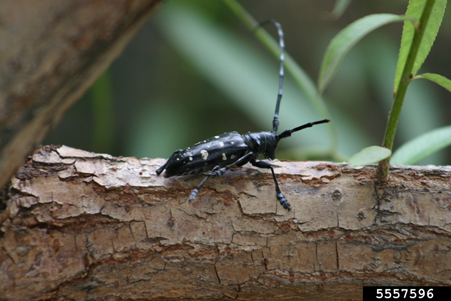
One particularly destructive beetle species, the Asian longhorned beetle (ALB) (Anoplophora glabripennis), is one of the most reputed invasive species globally and has become problematic in several regions to which it has been introduced. This voracious wood boring beetle, native to parts of Asia, feeds on and deposits its eggs within host trees.
After hatching from the deposited eggs, developing larval beetles feed on the tissue of the tree burrowing deeper into the wood, forming larval galleries and eventually boring exit tunnels and emerging as adults. Unlike many woodboring beetles that affect a single genus or species of plant host, ALB are less selective and may feed on many species of broadleaf trees belonging to several genera. In short- they are not picky eaters. This indiscriminate host selection contributes to the destructive capacity of ALB. The notoriety of ALB is reflected in its spot on the Invasive Species Specialist Group list of 100 of the worst invasive alien species.
The Detection
In 2003, an insect suspected to be Asian longhorned beetle was discovered in Vaughan, by a resident who handed the beetle to officials at the CFIA office located in Toronto. The specimen was forwarded to the to the CFIA’s Centre of Plant Quarantine Pests, in Ottawa, where entomology experts positively identified it as an Asian longhorned beetle. Following this confirmation, the top priority of the CFIA became determining whether this insect had recently been inadvertently transported and release to the Vaughan area, or whether a population of ALB had become established in the region.
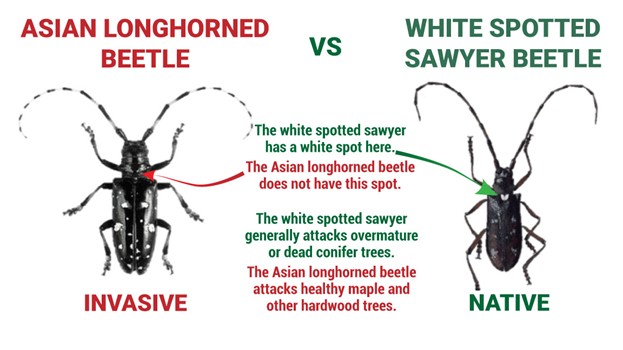
CFIA inspectors belonging to the Toronto Plant Health Division attended the site where ALB was discovered to perform surveys of commercial properties in the vicinity to identify any indications of ALB presence or introduction pathways. While surveying the property of a business with a history of importing glassware from China, inspectors located several tree stumps containing signs of injury from ALB, as well as wooden packaging materials such as crates and pallets. Also found at this site were a minimum of 50 trees containing evidence of ALB larval galleries, as well as a live adult beetle. These discoveries indicated the presence of a breeding population of this pest. This active ALB population located on the border between the cities of Vaughan and Toronto in Ontario, Canada marked the countries first occurrence of this species.

Aware of the severity of the threats posed by ALB, the CFIA took immediate actions to address the situation by implementing an emergency response program, which involved establishing a command centre, assembling a response team, procuring equipment required for emergency response, as well as informing partner organizations of the situation. Additionally, the public was informed of detection through news releases, and a toll-free hotline was initiated to receive reports of sightings or evidence of ALB. The initial objective of the emergency response plan was to determine the severity of the infestation and to identify any additional areas that may also be infested. Distinct science, communications, and operations subcommittees – comprising stakeholders and experts belonging to agencies of all levels of government of both Canada and U.S.A. -were formed to provide consultation and guidance in their areas of expertise. Although no previous ALB infestations had occurred in Canada, some of the committee members had managed outbreaks in major U.S. cities in previous years, providing valuable experience to draw from.
The science subcommittee outlined several objectives that would help the program achieve the greatest likelihood of success and aid future management efforts;
- Identify the initial site at which the ALB population became established.
- Gain a full understanding of the indications of injury caused by each life stage of ALB for more effective detection and diagnosis of injured trees.
- Determine which trees were most often selected and were most suitable as ALB hosts.
- Describe ALB galleries and tunnels in detail and be able differentiate them from those of similar native species.
- To formulate appropriate response procedures for detection and delimitation surveys, and identify the progression of colonisation of trees by ALB.
- Use locations of infested trees to understand the spread of the beetle through time and space to inform the establishment of regulated zones and guidelines that would help to ensure containment of the infestation and prevent it from spreading to natural forests.
- Gain a better understanding of the life cycle of ALB in Ontario.
Operation
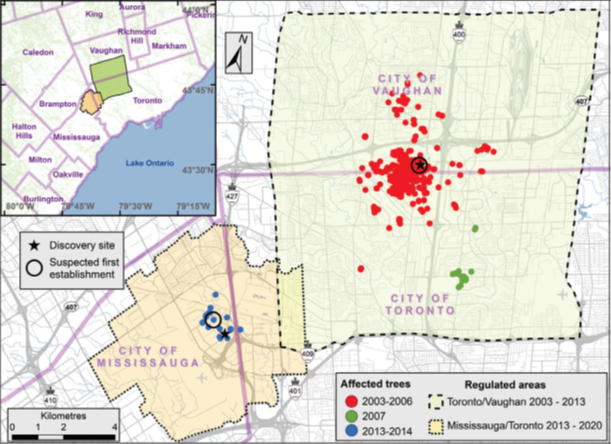
Delineation surveys, involving visual inspection of trees using binoculars, bucket trucks, and climbing tools were performed in the areas surrounding the discovery site were performed to establish the extent of the infested area and provide insight into what actions should be taken next. A 2 km radius surrounding the discovery site was considered the core infestation, while three additional areas outside this zone were found to contain injured trees and deemed satellite infestations. Informed by the findings of the surveys, and aware of the potential damage that the infestation could cause if spread to nearby forests, officials decided that the most appropriate management approach was to develop a plan aimed at eradicating ALB from the infested areas. Many factors, such as resource availability, effectiveness, as well as human and environmental health, needed to be considered when determining which protocols should be included in the eradication plan. Several resources, such as published literature related to ALB outbreaks, available data from previous ALB outbreaks, and advice from those who had first had experience dealing with ALB infestation, were consulted during the development of the plan. This information provided valuable insights such as which tree species may be vulnerable to attack, the potential rate of spread of the infestation, most effective treatment options, and how to best contain the infestation. Guided by this knowledge, a strategy focused on treatment and containment aspects was developed.
The plan would require inspection, classification, and treatment of trees within the area of infestation. Trees showing signs of attack from ALB were classified as injured, while trees of species known to host ALB and located in proximity of injured trees were classified as susceptible.
Sanitation operation
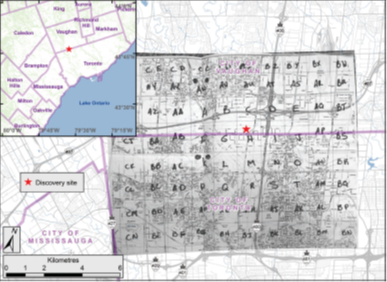
The CFIA trained inspectors to visually examine trees from the ground for signs of injury due to ALB. Teams of two inspectors were assigned to assess 1.25 x 1.25 km cells surrounding the discovery site to identify cells containing injured trees. These cells were then examined more thoroughly, with each injured or susceptible tree being marked. Following removal and destruction of the marked trees, stumps of the affected trees were treated by either grinding the stump to 45 cm below the surface or sprayed with herbicide to prevent regrowth. The stems and branches of each removed tree were ground or chipped down to a size of less than 1.5 cm in any dimension. To determine whether the implementation of synthetic insecticides would be appropriate for the eradication efforts, management consulted the available data and published literature regarding the use of these chemicals for controlling ALB, After carefully considering the estimated efficacy, and potential hazards associated with these chemical options, it was decided that insecticide application would not be included as a component of the treatment process.
Grid of 1.25 km x 1.25 km cells surrounding the discovery site, inspected for signs of ALB. (Image source: Turgeon et al. 2022)
A regulated quarantine area totalling 15,217 ha which, including the infested locations and a surrounding buffer zone, was established by the CFIA. This quarantine area would help to prevent the inadvertent movement of ALB to unaffected areas. Prior to being moved from the quarantine area, any trees of a species known to host ALB, and any other plant-related materials were subject to phytosanitary measures and inspections.
As the eradication program progressed and detailed information regarding the extent of the infestation became available, several treatment protocols and procedures were modified. The process of selecting which trees needed to be removed was altered to account for changes to the size of the buffer zones surrounding infested trees as well as which genera were considered highly susceptible within the buffer zones.
Removal of trees identified as infested or at risk, and subsequent treatment of stumps of the removed trees, occurred between 2003 and 2008. Follow up surveys of the infested areas were conducted for several years following treatment to ensure that no trees and stumps marked for treatment had been missed through the sanitation process and that ALB had indeed been eradicated from the areas. In 2013, it was determined that ALB had been successfully eradicated from the affected areas. However, later in 2013, reports of a previously undiscovered satellite population were confirmed 10 km away from the core infestation in Mississauga, Ontario, and eradication operations were initiated in this area. Guided by the knowledge gained throughout the previous operations, updated treatment and monitoring procedures led to successful eradication of the new satellite population, and the area was declared pest free in 2020.
2026 Scenario Modeling
In 2026 ISC partnered with Apex RMS (Apex Resource Management Solutions Ltd.) to create a modelling framework to assess the spread and management of Asian longhorned beetle in Ontario, with applications to both a historical infestation in Mississauga and a hypothetical future outbreak in Muskoka.
The model reproduced the observed dynamics of the historical 2013 Mississauga infestation.
Simulations show that rapid detection combined with aggressive management, specifically the removal of infested trees and surrounding host trees within an 800 m buffer, can lead to successful eradication within approximately 3–7 years.
Summary
In summary, this infestation and subsequent eradication showcases the impact and importance of coordinated collaboration and quick response, as well as attention to detail. The comprehensive data collection and analysis throughout the process allowed for protocols to be adjusted to increase the effectiveness of the strategy. The lessons learned and information gathered now serve as valuable resources to guide future efforts in managing invasions of ALB and other pests. While the loss of trees and cost of the eradication efforts were substantial, this was a small price to pay when compared to the economic, ecological and cultural impacts that would have been sustained had it not been for a rapid response to this invasion.
The primary source material referenced while writing this blog post was:
Turgeon JJ, Gasman B, Smith MT, Pedlar JH, Orr M, Fournier RE, Doyle J, Ric J, Scarr T. 2022. Canada’s response to invasion by Asian longhorned beetle (Coleoptera: Cerambycidae) in Ontario. The Canadian Entomologist. 154(s1):e1. doi:10.4039/tce.2021.60.
Learn more about ALB here!
If you believe that you’ve spotted ALB please report your sighting here!
