
Hammerhead worms are easily recognized by their flattened elongate bodies and distinct crescent- or-fan-shaped “hammerhead”. Individual species vary in size, some hammerhead worms only a few centimeters long, bodies stout and leaflike in shape, while other species may reach upwards of 30cm in length. Worms have a “creeping sole” on the underside of their body used for locomotion. In Canada there are 2 primary hammerhead worm species of concern:
Wandering broadhead planarian (B. adventitium): Yellow-tan with a single dorsal thin brown stripe. Ventral (belly) unstriped and pale. No dark collar, head is small and well-rounded with a grey-brown edge. Adults range from 5-10cm in length.

Photo: Bipalium adventitium. Observation © user Cricket Raspet 2022. iNaturalist.org
Shovel-headed Garden Worm (B. kewense): Light brown with five dorsal stripes. Stripes two and four are thicker and a deep grey in colour. Ventral side (belly) has two grey-violet stripes. Dark collar is broken dorsally; head is a dark grey-black. Adults range from 20-30cm in length.

Photo: Bipalium kewense. Observation © Jason Schock 2023. iNaturalist.org
Hammerhead worms reproduce both sexually and asexually; flatworms are hermaphrodites meaning a single individual possesses male and female reproductive organs allowing worms to mate with any other individual encountered. After mating, worms produce an egg capsule or cocoon which has a tough exterior and hosts numerous young. These cocoons hatch after about 23 days, producing between 1-8 offspring (Ducey et al. 2005). In their native range species primarily reproduce sexually, however, when introduced to cooler climates some species of invasive flatworms are unable to fully sexually mature. B. adventitium more often reproduces sexually while B. kewense only rarely produces egg cocoons, primarily reproducing through fragmentation (Ducey et al. 2007). Fragmentation occurs when a flatworm spontaneously pinches off a small portion of its body that begins to develop into a new individual over the course of about a week (Ducey et al. 2005; Hyman, 1940).
Hammerhead worms are generalist predators that detect prey using chemoreceptors located along their heads. Through these receptors, hammerhead worms are able to follow earthworm mucus and body secretion trails on or just below the soil surface. Once they locate prey, hammerhead worms will wrap around their target often “capping” the worm’s head with their own hammerhead and body to prevent escape. Hammerhead worms will then pierce the earthworm with a digestive organ known as an everted pharynx to begin breaking down their prey. Using this hunting strategy hammerhead worms are able to attack any species of earthworm, including those up to 100 times their size (Bertone et al. 2020; Fiore et al. 2004)!
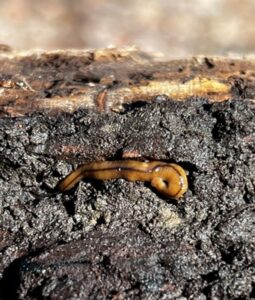
Photo: Bipalium adventitium. Observation © Sigrid Jakob 2024. iNaturalist.org;
Invasive land planarians require moist soil in humid environments that mirror the conditions of their native habitats. They are often found under rocks, logs, other debris, or in leaf litter, plant pots, mulch, and shrubs capable of retaining moisture. Following rain, land planarians may be found in areas typically too dry to inhabit otherwise such as yards or sidewalks. In areas with an appropriate temperature and humidity land planarians will remain active year-round.
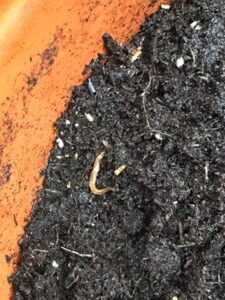
Photo: Bipalium adventitium. Observation © user feralbeetle 2019. iNaturalist.org
Flatworms are a highly diverse group of animals commonly recorded in the tropics of Australia, SE Asia, South America, and Africa, with numerous other species distributed worldwide. Reported as early as the 1900s in the United States, at least 15 species of land planarians are known to occur in North America only 2-4 of which are considered native (Skvarla, 2022). They were likely introduced as hitchhikers in potted plants, soil, and mulch. Although there are native land planarians in North America, the horticultural trade has expeditated the introduction of invasive hammerhead worms common in more tropical and subtropical regions. Invasive hammerhead worms typically occur along the eastern and western coasts of the United States.
The first report of the hammerhead worm Bipalium adventitium in Canada occurred in 2018 in Montreal, Quebec (Justine et al. 2019). Following the initial observation, several other individuals were identified in Montreal over the summer of 2018 and again in the spring of 2019. The majority of hammerhead worms were collected under stones or rotten logs (Justine et al. 2019). More recently hammerhead worms have been sighted in Ontario, Quebec, British Columbia, and Nova Scotia.
The map below is the EDDMapS (Early Detection & Distribution Mapping System) distribution map for invasive hammerhead flatworms as of June 2025.

EDDMapS. (2025). Early Detection & Distribution Mapping System. The University of Georgia – Center for Invasive Species and Ecosystem Health. Available online at http://www.eddmaps.org/
Ecological Impacts:
Hammerhead worms are generalist predators that voraciously feed on soil invertebrates including worms, slugs, snails, woodlice, larvae, springtails, other invertebrates, and even other land planarians. Often considered top predators in their native microhabitats, invasive hammerhead worms have the potential to negatively impact North American soil ecosystems by depleting important invertebrate populations. (Murchie & Gordon, 2013). This generalist diet and ability to quickly adapt to new environments allows land planarians to quickly establish themselves once introduced.
In Canada the two invasive land planarians of primary concern, Bipalium kewense and B. adventitium, are both predators of earthworms; although investigation into their impact on the environment is difficult to assess. Despite reducing worm populations, earthworm species found in Canada are also non-native with many species degrading forest soil quality and destroying leaf litter in their introduced ecosystems, as is the case with invasive jumping worms (https://www.invasivespeciescentre.ca/invasive-species/meet-the-species/land-and-animal-invertebrates/jumping-worms/). These invasive earthworms are found in urban or human disturbed sites, though they may populate undisturbed forests as well due to human traffic.
Given the number of native established flatworms in North America and the density of invasive earthworms in urban locations hammerhead worms are more likely to be introduced to, invasive hammerhead worms are considered unlikely to cause significant ecological impacts. However, their impact on other North American invertebrates has not been thoroughly investigated to date (Bertone et al. 2020; Ducey et al. 2005).
Economic & Social Impacts
Hammerhead worms in Canada are typically introduced to greenhouses and gardens with tropical or subtropical imported plants. In these settings, there is concern that hammerhead worms may reduce worm populations used for earthworm farming and vermicomposting, however this impact is rarely observed (Bertone et al. 2020).
Of the hammerhead worms found in North America, two species (Bipalium adventitum and B. kewense) have been identified as producing a neurotoxin, known as tetrodotoxin (TTX), the same toxin produced by pufferfish. The toxin, which is present in their mucous, is believed to be used to both paralyze their prey and act as a defense mechanism making worms unpalatable. The amount of toxin present is not known to be harmful to humans; however, caution should be taken when handling hammerhead worms as mild skin irritation is known to occur (Bertone et al. 2020; Skvarla, 2022). To prevent this, gloves should be worn, or hands should be washed immediately after handling. Hammerhead worms are not known to be fatal to smaller animals, such as dogs or cats, but can make them sick if ingested. Pets that have ingested the worms may vomit and feel unwell for a day or two.
Land planaria like many other native invertebrates can also carry the infective stage of rat lungworm (Angiostrongylus cantonensis), a parasitic internal nematode. Ingestion of raw or undercooked hosts (shrimp, crabs, frogs, worms, snails, slugs, etc) has the potential to result in human infection. To reduce risk of infection, always wash hands with hot soapy water and rinse with standard hand sanitizer immediately after handling land planarians (https://www.cdc.gov/angiostrongylus/causes/index.html).
Prevent Introduction
The primary pathway of introduction is believed to be through the human transport of potted exotic ornamental plants and soil. Avoid purchasing mulch, compost, nursery stocks, or potting mixes from areas with established hammerhead worm infestations as these may contain adult worms or egg capsules. Egg capsules are difficult to ID and may be easily mistaken for loose soil, seeds, or debris. If you reside and work in areas where hammerhead worms have been sighted, extra caution should be exercised to prevent accidentally spreading the worms from one location to another. Always inspect and clean gardening tools, equipment, and containers after their use.
Report Them
Early detection and rapid response (EDRR) is critical to managing the spread of hammerhead worms. Reporting a sighting is a great way to mitigate invasive species in your area. Investigate the soil of recently purchased potted plants or any plant acquired from a nursery for invasive worms before planting. If you find a hammerhead worm, sightings can be reported through iNaturalist or EDDMapS. Upload a photograph alongside your observation to help in confirming species identity.
Kill Them
Any hammerhead worms found should be reported and disposed of. Never cut up a hammerhead worm in an attempt to kill it. Land planarians may regenerate from individual fragments so cutting them up will only exacerbate the issue.
When handling live flatworms use gloves or tweezers, if contact is made hands should be washed in hot soapy water and rinsed in alcohol or a standard hand disinfectant. Avoid touching your eyes or mouth after contact with a hammerhead worm.
Individual worms can be killed by placing them in rubbing alcohol, salt, or by freezing them. Use tweezers, a stick, or gloves to grab the worm and place it in a plastic bag or container to ensure it cannot escape. Add rubbing alcohol or salt to the container before placing it in a freezer for several hours. Alternatively, place the container with the hammerhead worm in direct sunlight for several hours. Once the worm is dead, it should be kept within the container and disposed of in the trash.
