
What is Oak Wilt?
Oak wilt is a vascular disease of oak trees (Quercus spp.) that is caused by the invasive fungal pathogen Bretziella fagacearum. The fungus grows on the outer sapwood of oak trees, stimulating the host’s defense mechanisms which restricts the flow of water and nutrients throughout the xylem. The leaves of infected oaks will start to wilt and drop prematurely, eventually resulting in complete defoliation. Tree mortality is the final step, with severe cases occurring within 2 to 6 weeks post infection. While all species of oaks have been found to be susceptible to oak wilt, red oaks (Quercus rubra) are most severely affected. White oaks (Quercus alba) typically show far less damage and rarely die from oak wilt.
The fungus is spread both below-ground via root grafting from infected to healthy trees, and above-ground by means of fungal spore spreading by Nitidulid beetles or bark beetles. Anthropogenic movement of infected materials is responsible for the long-distance introduction of the fungus to new areas.
Bretziella fagacearum is believed to have been present in North America since the early 1900’s and has since been confirmed in 24 U.S. states, including Michigan, Ohio, Pennsylvania, and New York. In 2016, it was found on Belle Isle, MI, less than 1 km away from the shores of Windsor, Ontario.
Case Study: First Detection of Oak Wilt in Canada
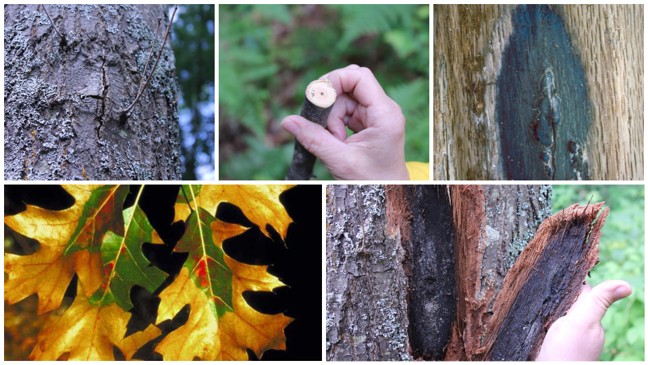
In early spring of 2023, a homeowner in Niagara Falls called an arborist to provide a quote for the removal of three dead standing oak trees on their property. When on site, the arborist noticed that the large trees were completely defoliated and had long vertical bark cracks that are characteristic of oak wilt. This prompted the arborist to call the city and make a report to the Canadian Food Inspection Agency (CFIA). Inspectors from the CFIA examined the trees and found several fresh fungal mats and pressure pads. Samples were taken and positive results were confirmed a few days later. The credible report and positive detection initiated a large rapid response that involved collaboration between several federal, provincial, municipal, and non-governmental partners. The three red oaks had died recently, and since they had viable pressure pads, they were at higher risk for oak wilt transmission. Plans to remove the trees were developed and implemented quickly in an attempt to limit the spread. Red oak trees throughout the area were also surveyed by the City of Niagara Falls (using their tree inventory database) and the CFIA to determine the extent of damage.
To remove the three infected trees, cranes were rented to lift them from the homeowners’ backyard. To prevent any contamination, all material from the crane was immediately loaded onto trucks which were covered with tarps during transit. All associated materials were disposed of at the municipal dump by means of deep burial. Stumps were painted and tarped tightly overnight until their removal the next day. This collaborative partnership required organization, which involved sign in/out sheets and extensive sanitization of small handheld tools, chainsaws, climbing gear, and even larger machines such as backhoes and trucks to minimize contamination and spread. As a result, three dead trees were removed in June 2023, then six infected trees were later removed in March 2024.
Estimating the Cost of Oak Wilt in Niagara Falls
Removal and stumping:
- Approximately $16,000 for removal + stumping of three infected trees
- Companies provided disposal, staff, cleanup
- Niagara paid for the crane rental at approx. $10,000 for the day (~ $10,000/14 hours = ~ $714/hour)
Disposal:
- Niagara paid the disposal fee of ~ $6,500 and included 40 metric tons of waste at a rate of $150/metric ton
- Contractor invoice included ropes, harnesses and equipment replacements
- CFIA handled sanitization
Total approximate cost per oak wilt infected tree:
- Including disposal, rentals, waste haulage, stumping, permits, equipment & replacements, total cost was ~ $33,000 for 3 trees
- That is approximately $11,000 per oak wilt infected tree
Additional costs to consider:
- Significant staff time spent training and surveying; 6 weeks of surveying
- Important to consider training, workshops, equipment replacement, labor costs and communication and coordinated messaging
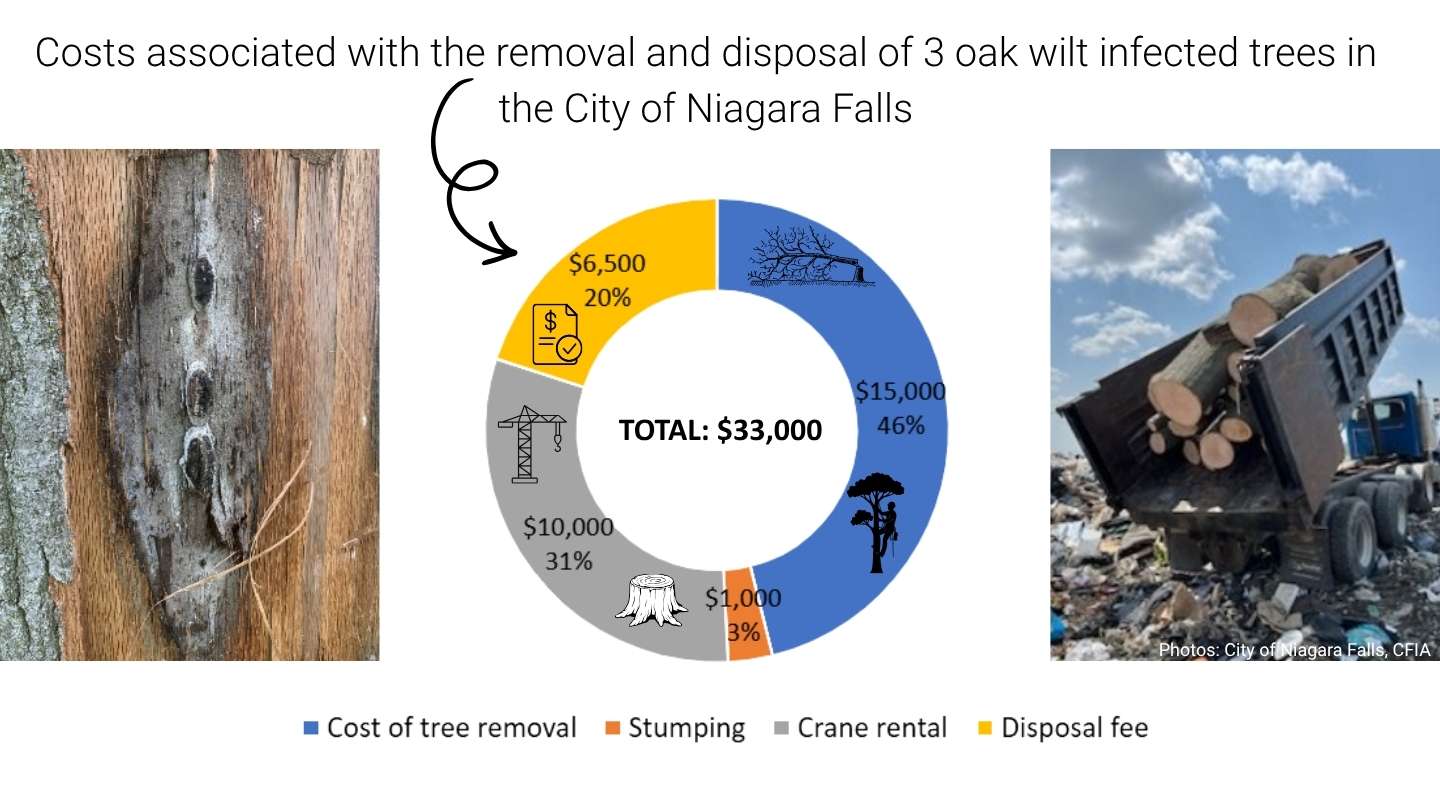
Data related to the first oak wilt detection in 2023 was obtained through discussions with forestry staff at the City of Niagara Falls who were directly involved in the detection, removal, and disposal of the infected trees.
Key Takeaways for Municipalities
– Bring attention of the threat of oak wilt to municipal leaders and decision makers:
- Attend city council meetings
- Speak with forestry managers
– Be aware of what surrounding municipalities are doing and not doing, work together where you can. Increase oak wilt surveillance and encourage public participation. Tips include:
- Staff training
- Attending workshops, training sessions, and webinars
- Requesting information
- Create or acquire fact sheets and make them available for staff and the public
- Make being up to date on threats as part of someone’s regular duties
- Ensure that field staff, arborists, foresters, and community members are knowledgeable on: When to prune oak trees, oak wilt symptoms, the use of pruning paint when pruning oaks, and how to report suspect finds
– Implement public outreach on oak wilt and firewood movement:
- Reach out to local media/news agencies
- Engage audiences through social media
- Attend local trade shows and expos
- Host public information sessions
- Connect with local NGOs and private organizations and develop new partnerships
- Include messaging at local parks and in public spaces
– Hire oak wilt certified arborists, or encourage your city arborists to gain oak wilt certification
– Issue pruning contracts for utility pruning to take place during low risk periods
– Develop proper sanitation methods and waste treatments for pruned clippings and waste. Suitable options include:
- Burning or burying;
- Debarking, splitting, or drying;
- Processing into lumber chips for mulching or fuel; or
- Processing into firewood (cover with plastic and seal between April and August)
– Use pruning paint if pruning must be done during high-risk periods
– Identify vulnerable resources, conduct an oak inventory
– Have an action plan in place in case of oak wilt detections in your municipality, especially in border communities or communities that see high traffic in and out of the area.
If you think you’ve seen oak wilt, report your sighting to www.eddmaps.org, 1-800-563-7711, or directly to the Canadian Food Inspection Agency at OakWiltReportingOntario-Fletrissementduchene@inspection.gc.ca
